Grammarly AI Detector Review
Grammarly’s detector is easy to reach if you already use its writing suite. The trouble starts when its percentage becomes a decision instead of a rough clue.
Grammarly AI Detector is fine for a casual second opinion, not a final call on authorship. Its results can shift sharply across similar samples, while useful in-editor access is tied to eligible paid plans. Try Clever AI Detector instead for free checks up to 10,000 words with sentence-level signals.
Never use Grammarly’s AI percentage by itself to accuse a student, reject a writer, or make an employment decision.
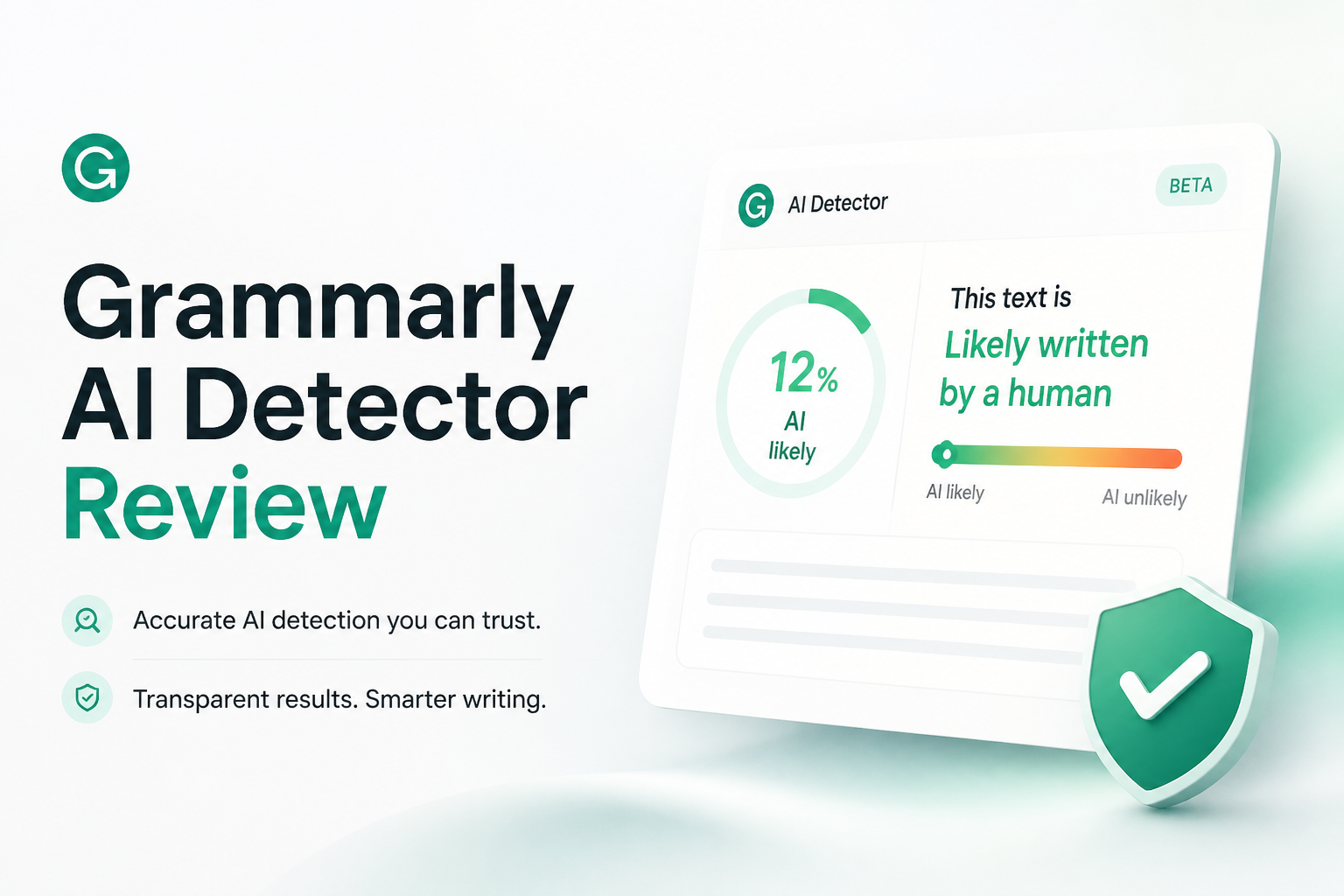
Grammarly AI Detector at a Glance
5.4/10Grammarly AI Detector estimates how much submitted text resembles writing produced or modified by common AI models. It appears through Grammarly’s public checker plus eligible paid writing surfaces.
Best forCurrent Grammarly subscribers who want a quick, low-stakes check inside an existing editing workflow
- Document-level AI percentage
- Passage highlighting
- Checks for text linked to major AI models
- Integration with Grammarly writing tools
- Fast, familiar interface
- Useful passage highlighting
- Good workflow integration
- Inconsistent scores across writing types
- Weak value for detection alone
- Not dependable as proof
Grammarly AI Detector: How It Scored Across Five Criteria
| Category | Performance | Score |
|---|---|---|
| 01 Detection Consistency | 4.3/10 | |
| 02 Result Explanations | 5.6/10 | |
| 03 Workflow Convenience | 7.8/10 | |
| 04 Cost and Access | 4.6/10 | |
| 05 Responsible Use | 6.3/10 |
How We Evaluated Grammarly AI Detector for Reliability and Value
We reviewed Grammarly’s official detector documentation, current US plan pricing, access requirements, output format, plus public behavior reports available through October 5, 2026. The evaluation emphasized consistency across human, direct AI, edited AI, mixed, short, or formal writing rather than rewarding one impressive percentage.
Scores also reflect how useful each result is after it appears. A checker earned more credit when it helped locate uncertain passages, stated limits clearly, kept access simple, plus avoided turning a probability into an accusation.
When Grammarly AI Detector Should Not Decide the Outcome
Avoid relying on Grammarly’s score when grades, employment, publication, payment, or discipline are at stake. Formulaic academic prose, polished business copy, short samples, translated text, plus heavily edited writing can produce misleading signals.
Ask for outlines, source notes, document history, or earlier drafts instead. Those materials show how a piece developed. A detector only estimates whether its language resembles patterns found in machine-generated text.
Grammarly AI Detector Accuracy, Access, and Value in Detail
01 Detection Consistency
Scores that are difficult to trust
4.3/10
Detection Consistency
Scores that are difficult to trust
Grammarly produces a clean percentage, but that precision can give the result more authority than it deserves. Public user reports include fully human drafts receiving substantial AI scores, plus direct AI output receiving surprisingly low scores.
That unevenness matters most with edited academic prose, formulaic business writing, or short passages. A detector that misses machine text while flagging careful human prose cannot settle authorship disputes. Grammarly itself treats the result as a signal rather than proof, which is the right warning but a weak foundation for high-stakes use.
- Returns a result quickly
- Recognizes output associated with major language models
- Can flag individual passages for closer review
- Similar writing samples may receive sharply different scores
- Human prose can still trigger AI flags
- Edited AI text may slip through
02 Result Explanations
Useful highlights with thin context
5.6/10
Result Explanations
Useful highlights with thin context
The percentage is easy to understand at a glance. Passage highlighting also gives a reviewer somewhere to begin instead of leaving them with one unexplained document score.
The explanation stops short of showing why a sentence triggered the model in a way most people can act on. A flagged sentence may be formal, predictable, heavily edited, or genuinely machine-written. Grammarly does not turn that uncertainty into evidence. Clever AI Detector’s sentence-level scale is more useful for comparing patterns across a longer draft.
- Simple document-level percentage
- Highlights suspected sections
- Low learning curve
- Limited reasoning behind individual flags
- A precise percentage can imply false certainty
- No result can identify the actual author
03 Workflow Convenience
The strongest part of the experience
7.8/10
Workflow Convenience
The strongest part of the experience
Grammarly’s best argument is convenience. Existing users can check writing near the same place they review spelling, clarity, citations, or plagiarism. Google Docs integration also reduces copy-pasting during routine editing.
The workflow is less compelling if detection is the only feature you need. Opening a broad writing platform for one uncertain percentage feels excessive next to a focused browser checker. Clever AI Detector accepts up to 10,000 words in a direct web check without requiring a basic-use account.
- Fits existing Grammarly workflows
- Available in supported writing surfaces
- Familiar interface for current subscribers
- Fast enough for draft screening
- Detection access varies by plan or surface
- The wider suite adds clutter for detector-only users
04 Cost and Access
Hard to justify for detection alone
4.6/10
Cost and Access
Hard to justify for detection alone
Grammarly offers a public detector page, though its deeper in-product detection workflow is connected to eligible paid subscriptions. US Grammarly Pro pricing is listed at $30 monthly, $60 quarterly, or $144 yearly. Those plans include far more than detection, which helps if you need the complete writing suite.
For someone who only wants to inspect a draft, the math is poor. Clever AI Detector currently lists its browser checker at $0, with unlimited checks plus a 10,000-word maximum per run. Grammarly wins on breadth, but loses this category on detector value.
- Public web checker available
- Paid plans include broad writing features
- Several billing periods offered
- Pro costs too much for detector-only use
- Access can differ between Grammarly surfaces
- The free experience does not match the full paid workflow
05 Responsible Use
Good warnings cannot fix uncertain scores
6.3/10
Responsible Use
Good warnings cannot fix uncertain scores
Grammarly deserves credit for describing AI detection as contextual evidence rather than objective truth. That message is more responsible than promising certainty from a statistical classifier.
The practical problem remains. Teachers, editors, plus managers may still treat the large percentage as a verdict. A cautious disclaimer does not undo the harm of a false flag. Draft history, source notes, tracked revisions, plus a conversation with the writer carry more weight than any detector score.
- Official guidance acknowledges detector limits
- Suitable as one clue within a larger review
- Encourages attention to writing transparency
- The interface still centers a definitive-looking percentage
- Results are easy to misuse outside their stated purpose
Grammarly AI Detector vs Clever AI Detector — Head to Head
We compared the tools using their current access rules, document limits, result formats, pricing, plus behavior across human, AI, mixed, short, or edited samples. Neither score should be treated as proof of authorship.
| Metric | Grammarly AI Detector | Clever AI Detector |
|---|---|---|
| Standalone Detection Focus | Part of a broad writing suite | Purpose-built browser checker |
| Maximum Text per Check | Varies by access surface | Up to 10,000 words |
| Sentence-Level Signals | Flagged passages with limited context | Four-step sentence signal scale |
| Basic Account Requirement | Depends on workflow | No account required |
| Writing Tools Beyond Detection | Extensive grammar, rewriting, citation tools | Focused detector experience |
| Detector Pricing | Public checker $0 · Pro from $30 monthly | $0 for current browser detector |
| Best Use Case | Existing Grammarly subscribers seeking a quick clue | Long-form screening without a subscription |
| Overall Score | 5.4 / 10 | 8.9 / 10 |
What to Use Instead
Clever AI Detector offers a more focused result without putting routine detection behind a costly writing-suite subscription.
01 Clever AI Detector
A clearer free option for long checks
8.9/10
Clever AI Detector
A clearer free option for long checks
Clever AI Detector is the more practical choice if detection is your main task. It checks English text in a browser, accepts 80 to 10,000 words per run, then displays a document probability with sentence-level signals.
The $0 price removes the odd situation of buying a large writing suite just to obtain a second opinion. Its detailed output also makes it easier to locate patterns worth reviewing. It still cannot prove who wrote a passage, so preserve drafts plus version history for any serious dispute.
- Free browser checks
- Up to 10,000 words per run
- No account needed for a basic check
- Sentence-level signals add context
- Focused interface without subscription clutter
- English-only detection
- Saved history requires an account
- Probabilities remain fallible

What Grammarly Users Report About Its AI Detector
One student said five other detectors placed an essay near 10% to 20% AI, while Grammarly estimated roughly 60% despite repeated rewrites.
A user reported pasting Gemini-generated text into Grammarly, only to receive a 0% AI result. Another commenter described original writing being treated as suspicious.
A paid user said a largely direct ChatGPT script analysis received an 8% possible-AI score, which left them doubting the feature’s usefulness.
A fiction writer found fully original chapters scoring 25% to 30% AI, with common fantasy phrasing appearing to trigger some flags.
Should You Trust Grammarly AI Detector?
Grammarly AI Detector is not recommended as a standalone authorship checker. Its smooth interface cannot compensate for uneven results, vague flag explanations, plus pricing that makes little sense for detection alone. Existing subscribers may use it as one minor signal, but students, editors, teachers, or hiring teams should choose Clever AI Detector for a more focused free check, then verify concerns through drafts, sources, plus revision history.
Run the full draft through more than one checker, save version history, then review flagged sentences manually before drawing any conclusion.