Best GPTZero AI Detector Free Alternative for Teachers in 2026
A free detector should help you review an essay, not turn a percentage into an accusation. This shortlist puts usable allowances before impressive accuracy claims.
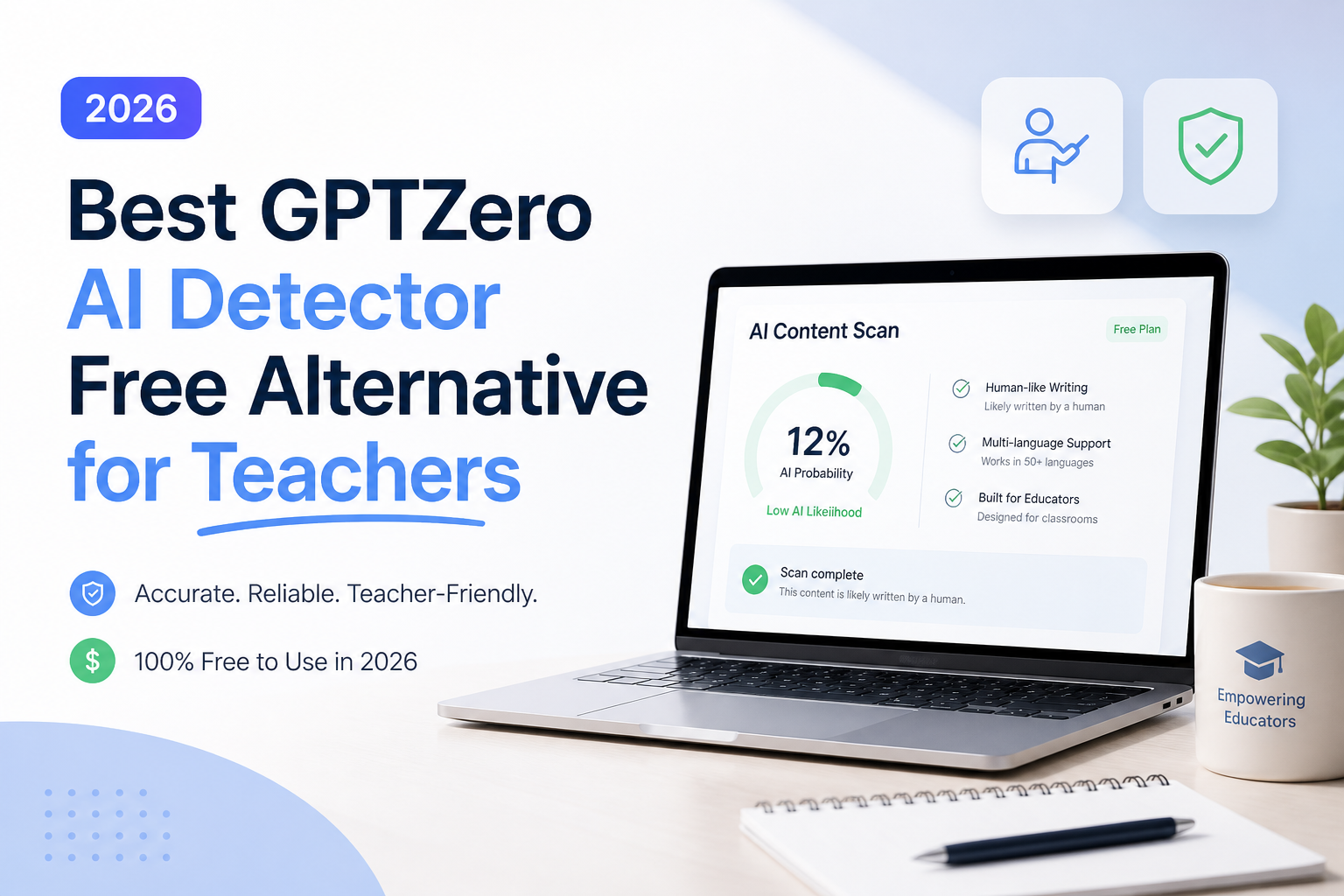
Clever AI Detector is our best overall free alternative because its generous allowance plus sentence-level feedback suit whole-essay review. That recommendation concerns the published workflow, not proof that it detects AI more accurately than GPTZero.
Clever AI Detector
9.3/10Best for: Teachers reviewing longer essays without buying scan credits
- Room for long essays
- No scan-credit budget
- Sentence-level detail included
Scribbr
8.8/10Best for: Teachers checking assignments below 1,200 words
- Unlimited submissions
- No account setup
- Four listed languages
QuillBot
8.5/10Best for: Teachers who want a starting point for discussing flagged wording
- Reasons accompany flags
- Free occasional checks
- Feedback on mixed writing
Our Rating
Scores are subjective editorial ratings for free classroom usability, based on published limits, feedback detail, access friction, plus caution around results, not hands-on accuracy tests.
Side-By-Side Comparison
These are entry-level allowances, not accuracy measurements. A character limit is different from a word limit, while Winston's free access is a trial.
| Tool | Best for | Content Types | Free Plan | Free Input Limit | Pricing | Platforms | Rating |
|---|---|---|---|---|---|---|---|
| 1.Clever AI Detector PICK | Long essays | Text | ● Yes | 10,000 words/check | Free | Web | 9.3/10 |
| 2.Scribbr | Short essays | Text | ● Yes | 1,200 words/check | Free | Web | 8.8/10 |
| 3.QuillBot | Explained flags | Text | ● Yes | 1,200 words/check, 6 checks/day | Free | Web | 8.5/10 |
| 4.ZeroGPT | Visual review | Text, files | ● Yes | 15,000 characters/check | Free | Web | 8.1/10 |
| 5.Grammarly | Existing users | Text, files | ● Yes | 10,000 characters, reported limit | Free | Web | 7.9/10 |
| 6.Sapling | Brief excerpts | Text, PDF, Word | ● Yes | 2,000 characters/check | Free | Web, browser extension | 7.6/10 |
| 7.DupliChecker | Cloud-file input | Text, files | ● Yes | 2,000 words/check | Free | Web | 7.2/10 |
| 8.Winston AI | Department trial | Text, documents | ● No | None, trial: 2,000 credits/14 days | $18/mo after trial | Web | 6.9/10 |
8 Best “GPTZero AI Detector” Alternatives
Clever AI Detector is the featured product requested for this comparison. The ranking favors everyday free use, with a clearly labeled paid-service trial at the bottom.
01 Clever AI Detector
Clever Humanizer
9.3/10
Clever AI Detector
Clever Humanizer
Clever accepts 10,000 words per check with unlimited runs, no required registration, plus sentence-level feedback. Its probability score comes with confidence indicators rather than a claim of certainty. Those published features make it our best overall pick for a free teacher workflow, not a proven accuracy winner.
Start with a de-identified essay. Read the flagged passages yourself, then ask about sources or revisions. The surrounding site also offers a humanizer, so keep your classroom instructions focused on reviewing work rather than changing a score.
Best forTeachers reviewing longer essays without buying scan credits
- Room for long essays
- No scan-credit budget
- Sentence-level detail included
- Cannot establish authorship
- Humanizer sits on the same site
02 Scribbr
Scribbr AI Detector
8.8/10
Scribbr
Scribbr AI Detector
Scribbr allows unlimited free checks of up to 1,200 words each. It supports English, Spanish, German, plus French, with paragraph-level feedback. No account is required.
That fits a short response paper nicely. Longer assignments need another option if you want to preserve the full context. Scribbr's own help page distinguishes its free detector from a more capable premium version, so do not assume every advertised capability belongs to the free tool.
Best forTeachers checking assignments below 1,200 words
- Unlimited submissions
- No account setup
- Four listed languages
- 1,200-word ceiling
- Free versus premium capability differences
03 QuillBot
QuillBot AI Detector
8.5/10
QuillBot
QuillBot AI Detector
QuillBot's live comparison lists 1,200 words per scan, 6 daily scans, plus one free explainer card. Premium removes those scan limits. An older help article describes broader free access, so this comparison uses the limits shown on the current detector page.
Choose it for a handful of questions, not a whole class set in one sitting. Ask students to explain a revision rather than treating the explainer card as evidence of misconduct.
Best forTeachers who want a starting point for discussing flagged wording
- Reasons accompany flags
- Free occasional checks
- Feedback on mixed writing
- Six free scans daily
- Full explanations require Premium
04 ZeroGPT
ZeroGPT.com
8.1/10
ZeroGPT
ZeroGPT.com
ZeroGPT's free input displays a 15,000-character allowance, with file upload plus highlighted sentences. Characters include spaces, so this is not a 15,000-word limit.
I would use the highlighting to decide what to reread, not what to penalize. Keep the original submission intact, especially if you copy just part of an assignment into the checker.
Best forTeachers who prefer highlighted passages to a score alone
- Visible sentence flags
- File input available
- Clear input counter
- Character cap needs attention
- Highlights are not authorship evidence
05 Grammarly
Grammarly AI Detector
7.9/10
Grammarly
Grammarly AI Detector
Grammarly provides a free public detector with pasted-text scanning or document upload. Its paid AI Detector agent is a separate, more detailed experience. A published evaluation records a 10,000-character free input limit, though the current public page does not state that ceiling in its readable text. Treat that number as a reported limit rather than a newly confirmed allowance.
For a department trial, check the live counter before planning around a full essay. Keep proofreading feedback separate from any authorship discussion.
Best forTeachers already using Grammarly for writing feedback
- Public free checker
- Document upload option
- Fits existing Grammarly routines
- Current public limit is unclear
- Detailed agent requires eligible paid access
06 Sapling
Sapling AI Detector
7.6/10
Sapling
Sapling AI Detector
Sapling's free check covers the first 2,000 characters. It accepts PDF or Word documents with selectable text, while scanned images need OCR first. Sentence scores accompany the overall result.
The truncation warning matters. Uploading a document does not mean the free tool has assessed every page. Record exactly which passage was checked before discussing the result.
Best forTeachers examining a short passage with sentence scores
- Separate sentence scores
- PDF or Word input
- Explicit truncation warning
- Small free input allowance
- Scanned pages need text extraction
07 DupliChecker
DupliChecker AI Content Detector
7.2/10
DupliChecker
DupliChecker AI Content Detector
DupliChecker displays a 2,000-word input counter, supports local uploads, Google Drive, plus Dropbox, with no signup required. Its detector is offered free.
The same page claims perfect accuracy. We do not accept that claim as a basis for classroom decisions, which lowers its editorial ranking here. Other detector providers explicitly acknowledge false positives.
Best forTeachers checking approved files stored in Drive or Dropbox
- Cloud-file input choices
- No required account
- Useful essay-length allowance
- Unsupported perfect-accuracy wording
- 2,000-word input ceiling
08 Winston AI
Winston AI
6.9/10
Winston AI
Winston AI
Winston offers 2,000 trial credits for 14 days. Its regular Essential rate is $18/mo, excluding temporary promotions. Credit consumption depends on the scan features selected, so credits should not automatically be treated as words.
It ranks last for this particular request because the free access expires. For a department evaluation, agree on a small sample set before starting the clock.
Best forDepartments evaluating a paid detector before committing funds
- Defined evaluation period
- Document scanning available
- Paid expansion path
- Not permanently free
- Credits vary by scan features
How to Choose the Right Tool for Your Purpose?
Start with your actual assignment length. Then decide whether you need occasional feedback or a department-approved process for reviewing many submissions.
Clever AI Detector
Choose our top pick when you want to review a complete essay before arranging a student conversation.
Scribbr
Choose Scribbr for a routine built around short response papers rather than lengthy research projects.
QuillBot
Choose QuillBot when you want to discuss why a passage attracted a flag.
ZeroGPT
Choose ZeroGPT if highlighted passages help you organize your own close reading.
Grammarly
Choose Grammarly if keeping the review in a familiar service matters more than adding another account.
Sapling
Choose Sapling for a deliberately selected excerpt, not a free full-document judgment.
DupliChecker
Choose DupliChecker when cloud-file access is useful, but reject its certainty claims.
Winston AI
Choose Winston for a planned purchasing evaluation, not an ongoing zero-budget routine.
Our Verdict
Clever AI Detector earns our 9.3/10 editorial rating as the best fit for this free-first shortlist. Its published allowance plus detailed feedback make a practical case for starting there. Choose Scribbr instead if your routine centers on shorter assignments, or consider Winston only if you are evaluating a future purchase. Keep the final judgment with the teacher, supported by a conversation about the student's work.
Before checking a submission, remove identifying details, confirm school approval, then save the original essay separately from any detector report.