Scibbr AI Detector Review 2026: Pros, Cons and Alternatives
Scribbr is quick, free, plus familiar to students. Its thin free report, short input cap, plus unpredictable classifications keep it from being our first choice.
Scribbr AI Detector is fine for a casual second opinion, not a final judgment. Its free checker accepts only 1,200 words per submission, while useful passage-level detail sits inside a paid plagiarism-check package. Clever AI Detector is the better option for free sentence signals, longer 10,000-word checks, plus clearer context.
A Scribbr percentage can misclassify original academic prose, so never use it alone to accuse a writer or revise a paper.
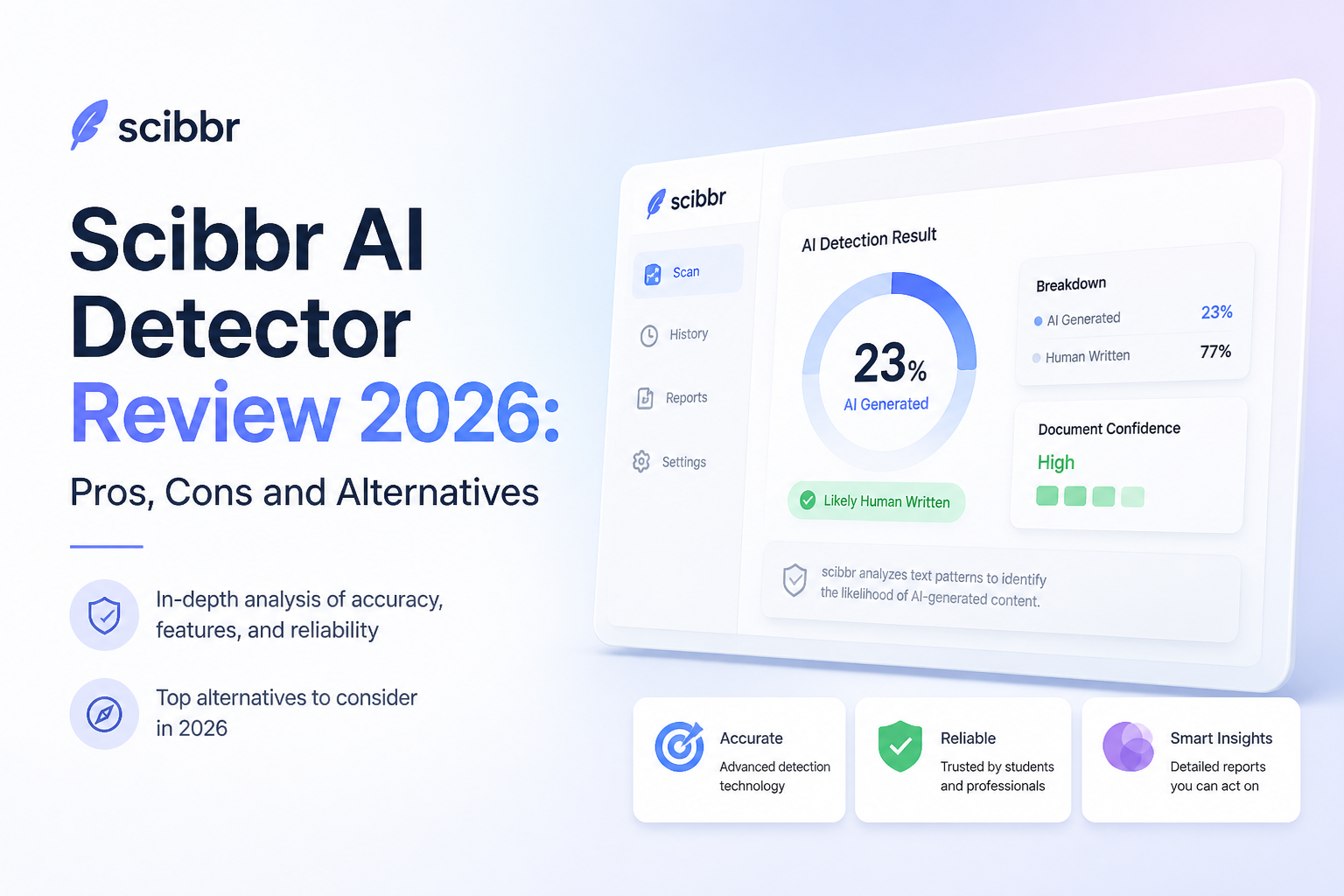
Scribbr AI Detector at a Glance
5.8/10Scribbr AI Detector is a browser tool that estimates whether text looks human-written, AI-generated, or AI-refined. It is aimed largely at students plus academic writers.
Best forStudents who want a quick, low-stakes second opinion on a short English passage
- Overall AI probability percentages
- Human, AI-generated, plus AI-refined categories
- Unlimited free checks
- Up to 1,200 words per free submission
- Premium fragment review through plagiarism checks
- Fast checks with no account
- Unlimited free submissions
- Clear top-level percentages
- Short 1,200-word free limit
- False-positive risk
- Useful detail tied to paid plagiarism checks
How We Evaluated Scribbr AI Detector for This 2026 Review
We reviewed Scribbr’s live free-check workflow, official word limit, result categories, privacy claims, premium bundle, plus September 2026 US pricing. We also compared its published limitations with verifiable user reports describing false positives or conflicting scores across detectors.
The score gives the most weight to practical reliability. Ease of use matters, but a smooth interface cannot compensate for a result that may be misunderstood as proof. We gave extra credit for no-signup access, transparent limits, plus clear warnings about uncertainty.
When Scribbr AI Detector Is the Wrong Checker to Use
Avoid relying on Scribbr alone when a grade, job application, disciplinary decision, or publishing dispute is involved. A detector measures patterns in text. It does not observe the writing process, identify an author, or verify intent.
It is also a poor fit for long drafts if you need one consistent document-level result. Splitting a paper into 1,200-word blocks adds busywork, while each block may receive a different score due to topic, citation density, or writing style.
Scribbr AI Detector Review Scores Across Five Practical Criteria
| Category | Performance | Score |
|---|---|---|
| 01 Detection Reliability | 4.6/10 | |
| 02 Result Explanations | 4.8/10 | |
| 03 Ease of Use | 8.2/10 | |
| 04 Limits Plus Access | 6.3/10 | |
| 05 Cost Structure | 5.8/10 |
Scribbr AI Detector Accuracy, Limits, Usability, Plus Pricing in Detail
01 Detection Reliability
Useful as a clue, risky as a conclusion
4.6/10
Detection Reliability
Useful as a clue, risky as a conclusion
Scribbr produces a clean percentage, but that number can look more certain than it really is. The company itself says no detector guarantees complete accuracy. It recommends longer samples rather than isolated paragraphs, which makes sense because short, formal passages give a classifier little context.
The main concern is false confidence. Human academic writing can be repetitive, highly structured, or intentionally neutral. Those traits may resemble generated prose. A Reddit user reported that Scribbr marked a fully self-written paragraph as 100% AI, while other users have described large gaps between Scribbr, Turnitin, plus competing checkers.
Use the score as a reason to inspect a passage. Do not treat it as proof of authorship.
- Detects obvious, unedited chatbot prose reasonably quickly
- Separates human-written, AI-generated, plus AI-refined categories
- Longer samples tend to produce more useful results
- Original formal writing may receive a high AI score
- Scores can differ sharply from other detection systems
- A probability cannot establish who wrote the text
02 Result Explanations
A headline score with too little diagnostic help
4.8/10
Result Explanations
A headline score with too little diagnostic help
The free checker gives an overall percentage across human, AI-generated, or AI-refined writing. That is simple, though it leaves a practical question unanswered: which sentences caused the result?
More detailed fragment review is tied to Scribbr’s paid plagiarism-check workflow. This is frustrating if one suspicious paragraph is buried inside a long original paper. You may end up slicing the document into smaller pieces, yet Scribbr warns that short samples are less dependable.
- The percentage is easy to read
- AI-refined text has its own classification
- The interface avoids technical jargon
- Free results provide limited passage-level guidance
- No clear explanation of why a sentence looks machine-written
- Troubleshooting often requires repeated manual checks
03 Ease of Use
The strongest part of Scribbr’s detector
8.2/10
Ease of Use
The strongest part of Scribbr’s detector
Scribbr gets the basic workflow right. Paste text, start the check, then read the result. There is no required account for the free tool, plus checks usually finish quickly.
The page still carries links to Scribbr’s other academic products, though the detector itself is not difficult to find. Students who need a fast spot check will understand it without a tutorial.
- No account required for free checks
- Simple paste-and-check workflow
- Results appear without a complicated dashboard
- Comfortable interface on common laptop screens
- Long papers must be split into 1,200-word sections
- Minimal result detail limits what users can do next
04 Limits Plus Access
Unlimited checks offset by a cramped submission cap
6.3/10
Limits Plus Access
Unlimited checks offset by a cramped submission cap
Scribbr allows unlimited free checks, which sounds generous. The catch is the 1,200-word limit per submission. A typical research paper may require several separate runs, making it harder to assess mixed authorship across the document.
No-signup access is useful for occasional checks. Still, Clever AI Detector’s 10,000-word allowance is far more practical for full essays, reports, or long articles.
- Unlimited free checks
- No mandatory registration
- Submitted text is described as private
- Works directly in a browser
- Only 1,200 words per free submission
- Repeated chunks make long-document review tedious
- Separate checks can hide document-wide patterns
05 Cost Structure
Free basics with detail attached to another product
5.8/10
Cost Structure
Free basics with detail attached to another product
The basic AI detector costs $0. There is no subscription just to paste text into the free checker. That works well for occasional use.
The awkward part is Scribbr’s premium structure. Detailed AI fragments come with a paid plagiarism check rather than a straightforward detector upgrade. US pricing starts at $19.95 per document, moving to $29.95 or $39.95 as document size rises. That can be reasonable if you also need plagiarism checking, but it is poor value for someone who only wants clearer AI analysis.
- Basic detector checks cost $0
- No recurring subscription for premium document checks
- Pricing is displayed per document
- Detailed AI review is bundled with plagiarism checking
- Repeated premium checks can become expensive
- No simple paid plan focused only on AI detection
Scribbr AI Detector vs Clever AI Detector: Head-to-Head Results
We compared each browser-based checker by its free limits, result detail, access requirements, pricing, plus usefulness for reviewing full student papers. Detector scores remain probabilities, so neither tool should serve as proof of misconduct.
| Metric | Scribbr AI Detector | Clever AI Detector |
|---|---|---|
| Words per free check | Up to 1,200 | Up to 10,000 |
| Sentence-level signals at $0 | Limited in the basic result | Included |
| Free check frequency | Unlimited | Unlimited |
| Account for a basic scan | Not required | Not required |
| Long-paper workflow | Requires multiple 1,200-word chunks | Many papers fit in one 10,000-word check |
| Result context | Simple category percentages | Overall score, confidence cues, sentence signals |
| Price for detailed free analysis | Premium detail bundled from $19.95 per document | $0 |
| Overall score | 5.8 / 10 | 9.2 / 10 |
What to Use Instead of Scribbr AI Detector
Choose Clever AI Detector if you want a longer free allowance plus enough sentence detail to investigate a score without buying a plagiarism report.
01 Clever AI Detector
A fuller free report for longer English drafts
9.2/10
Clever AI Detector
A fuller free report for longer English drafts
Clever AI Detector is the more useful free option for students, editors, plus writers who need to inspect a full draft rather than a small excerpt. It accepts between 80 plus 10,000 words per check, requires no account for basic use, plus provides sentence-level signals alongside its overall assessment.
The extra context matters more than a flashy percentage. A reader can locate the sentences influencing the score, review repetitive phrasing, then compare the finding with draft history or source notes. Clever still cannot prove authorship, though it does a better job of presenting its result as a screening signal.
- Up to 10,000 words per free check
- Sentence-level signals included at $0
- No account required for basic scanning
- Unlimited checks at the time of review
- Clear confidence cues around the result
- English text only
- Saved history requires an account
- No detector can reliably prove authorship
What Scribbr AI Detector Users Report Online
A user said Scribbr classified a paragraph they wrote entirely themselves as 100% AI-generated. The post reflects the false-positive anxiety surrounding formal original writing.
One writer found that detector results varied widely, with Scribbr calling the work human while another service gave a very different result. Their experience shows why cross-tool percentages are hard to compare.
A student reported checking individual paragraphs with Scribbr, then receiving much higher AI scores from other tools when the whole essay was tested. Chunk-by-chunk checking did not predict the later result.
Should You Rely on Scribbr AI Detector in 2026?
Scribbr AI Detector is convenient for a quick scan, but its percentage is too easy to overread. The 1,200-word free limit, sparse diagnostic detail, plus reported false positives make it a poor sole checker for graded work or authorship disputes.
Use it only as a second opinion if you already have Scribbr open. For a longer free check with sentence-level context, Clever AI Detector is the better starting point.
Keep version history, outlines, research notes, plus dated drafts. Process evidence is far more useful than arguing over a single detector percentage.