GPTZero vs Turnitin
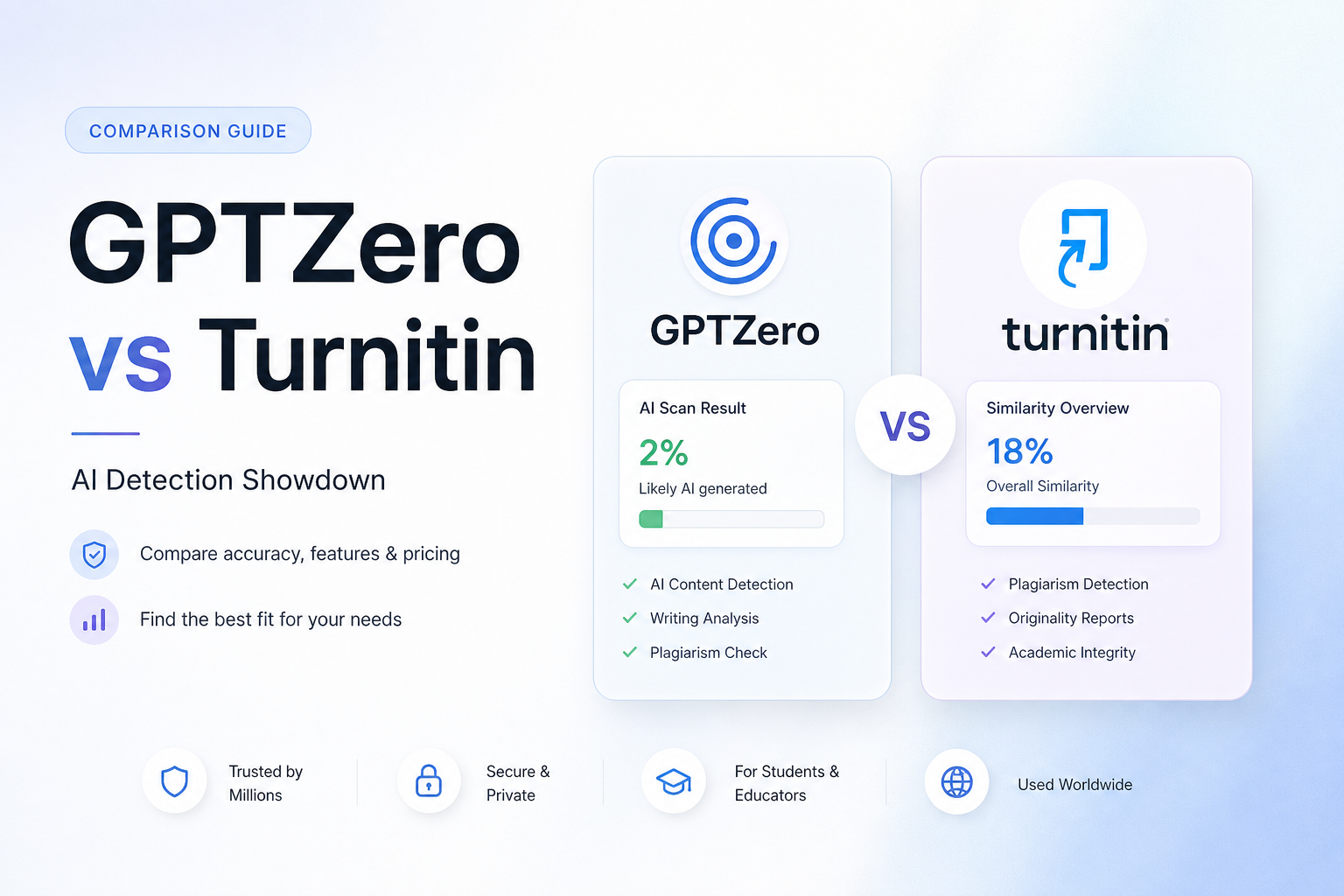
GPTZero is easier to test independently, while Turnitin fits institutional review. Here is a cleaner way to compare them without treating either score as proof.
Pick GPTZero for direct, self-service checks. Pick Turnitin when your school or organization already uses its submission plus similarity workflow. If the results affect a real person, inspect the highlighted prose, draft history, sources, plus policy before reaching a conclusion.
Do not treat an AI score as proof of misconduct. Both companies advise using detector output with context. Human writing can be flagged, while edited AI text can be missed. (guides.turnitin.com)
Revise Permitted AI-Assisted Prose → Clever AI Humanizer
Browser-based rewriting with multiple writing styles · Best used as an editing pass followed by manual source plus policy checks
Choose the Right GPTZero vs Turnitin Comparison Method
Start with access, then examine the report instead of chasing one percentage.
| Method | Best for | Time | Success rate |
|---|---|---|---|
| 1. Revise Permitted AI Text With Clever AI Humanizer TRY FIRST | Allowed AI-assisted revision | ~5 min | ● 90% |
| 2. Choose GPTZero or Turnitin by Workflow | Picking one platform | ~4 min | ● 95% |
| 3. Test the Same Writing Sample in Both Detectors | Direct comparison | ~10 min | ● 78% |
| 4. Separate AI Detection From Similarity Checking | Academic report review | ~8 min | ● 92% |
| 5. Investigate Conflicting Detector Results With Process Evidence | Disputes plus false flags | ~20 min | ● 88% |
When GPTZero or Turnitin Should Not Decide the Outcome
A detector should not settle a misconduct case, hiring decision, publication dispute, or grade by itself. Very short samples, highly formulaic prose, extensive editing, plus translated writing can leave too little reliable context.
Pause the automated review if private information, unpublished research, or protected student data cannot be uploaded under your organization’s rules. A supervised discussion or review of local document history may be safer.
What to Do When GPTZero Flags Text but Turnitin Does Not
First, confirm that both tools received the identical file. Then compare the highlighted sentences, since one platform may evaluate a different amount of qualifying prose or use a newer model release.
If the writing is genuinely human, gather outlines, browser research, version history, source annotations, plus earlier drafts. That evidence has more practical value than running the paragraph through five more detectors.
Top 5 Methods to Compare GPTZero With Turnitin
01 Revise Permitted AI Text With Clever AI Humanizer
Best for improving stiff wording when your class or workplace allows AI-assisted editing
~5 min
Revise Permitted AI Text With Clever AI Humanizer
Best for improving stiff wording when your class or workplace allows AI-assisted editing
Clever AI Humanizer rewrites mechanical passages with more varied phrasing. Use it only where AI-assisted revision is permitted, then treat the result as a new draft that needs fact-checking, citation review, plus disclosure when required. (cleverhumanizer.ai)
- Read the relevant AI policy before uploading any text, especially unpublished research or student work.
- Paste a passage of at least 30 words into Clever AI Humanizer, then choose a writing style that fits the assignment. (cleverhumanizer.ai)
- Run the rewrite once rather than stacking several transformations that may distort the meaning.
- Compare every sentence with your sources, restoring technical terms, quotations, plus citations where needed.
- Replace generic claims with your own analysis, examples, or observations, then disclose AI assistance if the rules require it.

02 Choose GPTZero or Turnitin by Workflow
Fastest way to decide which platform fits your actual role, access, plus review process
~4 min
Choose GPTZero or Turnitin by Workflow
Fastest way to decide which platform fits your actual role, access, plus review process
GPTZero offers direct text or file scanning, while Turnitin is commonly provided through an institution’s submission setup. Turnitin also places AI indicators beside its broader academic review tools, so access often settles the choice before detector performance does. (gptzero.me)
- Check whether your school, employer, or publisher already provides Turnitin access.
- Choose GPTZero when you need a self-service scan, shareable report, or quick review outside a learning platform.
- Choose Turnitin when the work must pass through an institution’s established submission plus integrity workflow.
- Confirm whether you need AI detection, source matching, citation review, or all three.
- Record the tool version plus scan date since model updates can change later results.
03 Test the Same Writing Sample in Both Detectors
Useful when you can access both tools plus want a fair side-by-side comparison
~10 min
Test the Same Writing Sample in Both Detectors
Useful when you can access both tools plus want a fair side-by-side comparison
A fair comparison requires identical text, similar timing, plus enough prose for each detector to evaluate. GPTZero says short or heavily edited passages are harder to classify, while Turnitin bases its percentage on qualifying text rather than every word in a submission. (gptzero.me)
- Save one clean copy of the document before scanning it anywhere.
- Remove appendices, reference lists, tables, plus quoted source blocks only if both tests will exclude the same material.
- Submit the exact same version to GPTZero plus Turnitin.
- Capture each overall result, highlighted passage, confidence label, plus scan date.
- Compare which sentences were flagged rather than treating two percentages as directly interchangeable.
- Repeat the test only after a meaningful revision, not after changing a few isolated words.
04 Separate AI Detection From Similarity Checking
Best for avoiding a common mix-up between machine-like prose plus copied source material
~8 min
Separate AI Detection From Similarity Checking
Best for avoiding a common mix-up between machine-like prose plus copied source material
An AI indicator is not a plagiarism finding. Turnitin’s Similarity Report identifies matching text, while its AI Writing Report estimates qualifying prose likely produced or modified through an LLM. GPTZero likewise offers AI analysis separately from its plagiarism-related features. (guides.turnitin.com)
- Open the similarity or plagiarism results separately from the AI-writing results.
- Review every source match to see whether it is quoted, cited, common phrasing, or genuinely unattributed.
- Inspect AI-highlighted passages for vague wording, fabricated facts, abrupt tone shifts, or unsupported reasoning.
- Fix citation problems with accurate attribution rather than simple synonym swaps.
- Rewrite weak analysis from your notes, source material, plus actual understanding.
- Keep separate records of citation corrections plus AI-related revisions.
05 Investigate Conflicting Detector Results With Process Evidence
Most reliable when GPTZero plus Turnitin disagree or a human-written passage gets flagged
~20 min
Investigate Conflicting Detector Results With Process Evidence
Most reliable when GPTZero plus Turnitin disagree or a human-written passage gets flagged
Neither platform says its output should serve as a final verdict by itself. Turnitin calls the score one data point, while GPTZero recommends using detection as a conversation starter backed by writing history plus context. (guides.turnitin.com)
- Preserve the original report, highlighted passages, submission date, plus assignment instructions.
- Collect outlines, handwritten notes, source annotations, earlier files, plus document version history.
- Review whether flagged passages contain standard definitions, formulaic academic wording, or language from a cited source.
- Ask the writer to explain the argument, evidence choices, plus revision decisions in their own words.
- Compare the disputed passage with earlier verified writing, while allowing for normal improvement or editing help.
- Make any academic decision from the full evidence rather than one detector percentage.
Which AI Detector Should You Use?
GPTZero is the simpler first choice for an independent scan, especially if you want to paste text directly or review sentence-level signals. Turnitin makes more sense inside a school’s existing integrity workflow, particularly where similarity checking plus instructor review already happen.
For permitted AI-assisted drafts, Clever AI Humanizer can make rigid prose easier to revise, but it should not be used to conceal authorship. Keep your source notes, inspect every changed claim, plus follow the policy that governs the work.
Choose by access first, compare identical text second, then rely on drafts, sources, plus writing history before making any high-stakes judgment.