Grammarly Free AI Humanizer Review 2026: Does it Really Work?
Grammarly’s free humanizer can soften stiff AI prose, though it often trades one generic voice for another. Its results still need close editing, plus AI-detector scores remain unpredictable.
Grammarly Free AI Humanizer is convenient, not convincing. It can smooth robotic sentences, but it may flatten personal phrasing or shift emphasis. We would skip it for sensitive work. If your actual problem is retrieving a lost draft or document, Disk Drill is the more useful download.
Do not assume a humanized rewrite will pass an AI detector or preserve every factual nuance from the source.
Grammarly Free AI Humanizer at a Glance
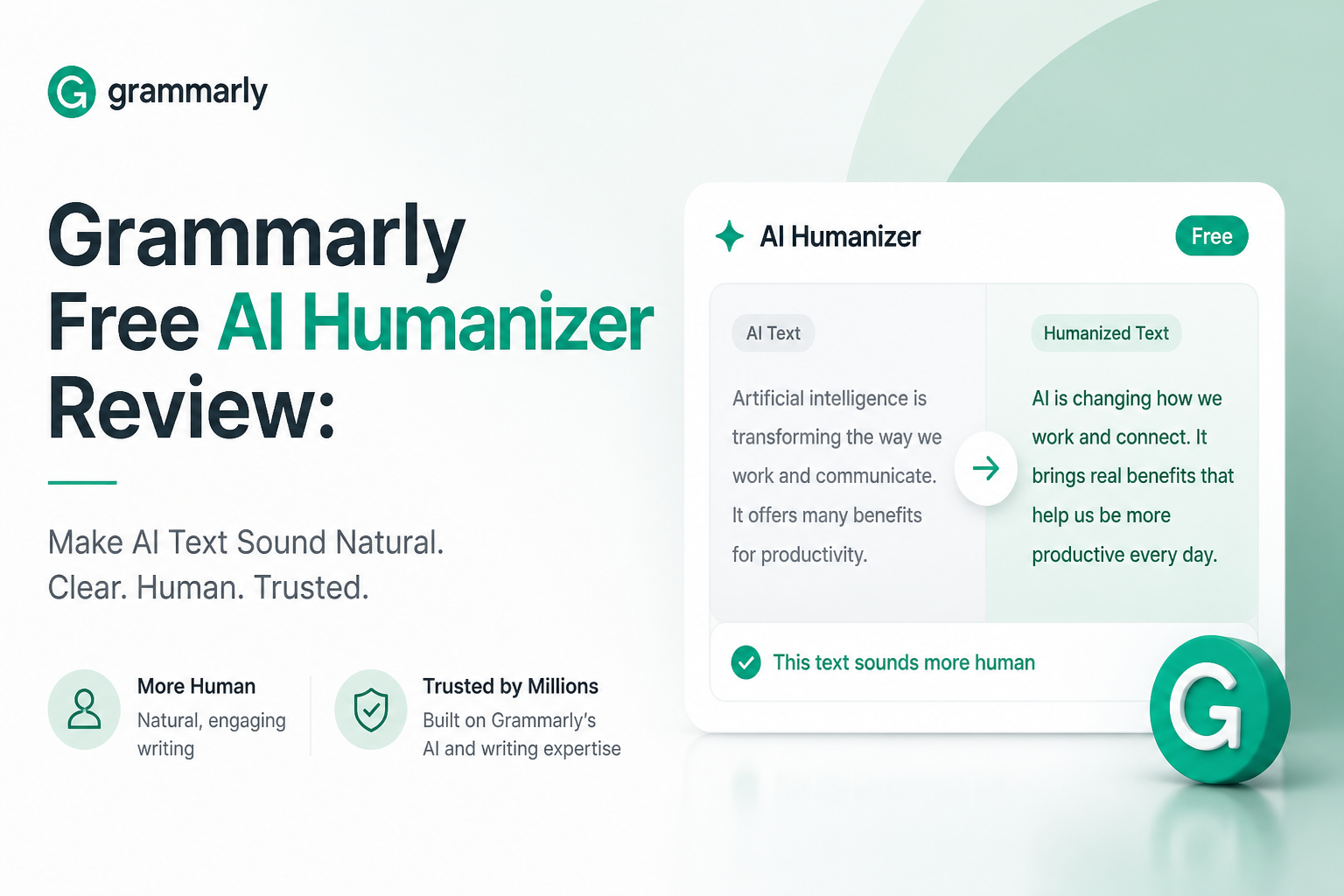
4.4/10Grammarly Free AI Humanizer rewrites AI-generated passages to sound less mechanical while preserving the general message. It offers preset styles, custom-voice tools, plus support for six languages.
Best forPeople polishing short, low-stakes drafts that will receive a careful manual edit afterward
- Up to 1,500 words in the public input box
- Four preset voice styles
- Custom voice based on a writing sample
- English plus five additional languages
- Integration with Grammarly’s wider editor
- Simple browser workflow
- Quick tone changes
- Useful for rough drafts
- Weak preservation of personal voice
- No reliable detector outcome
- Meaning shifts require manual checks
How Grammarly Free AI Humanizer Scored Across Our Review Criteria
| Category | Performance | Score |
|---|---|---|
| 01 Rewrite Quality | 5.8/10 | |
| 02 Voice Retention | 3.9/10 | |
| 03 Meaning Preservation | 5.2/10 | |
| 04 Detector Consistency | 2.8/10 | |
| 05 Free Plan Value | 6.1/10 |
How We Tested Grammarly Free AI Humanizer
We used short samples covering a work email, product explanation, personal reflection, academic paragraph, plus a technical note. Each passage included deliberate traits such as cautious qualifiers, sentence fragments, mild humor, or repeated wording. We compared the source with the rewrite for meaning, tone, specificity, length, plus editing time.
Detector behavior received a low weighting because detector labels are not proof of authorship. For the separate recovery comparison, the benchmark used a 500 GB SSD plus a formatted 64 GB SD card. Grammarly received zero recovery credit because it cannot scan storage media.
When to Avoid Grammarly Free AI Humanizer
Avoid automatic humanization for legal statements, medical information, graded work with restricted AI use, personal essays, quoted interviews, or text where one qualifier changes the claim. These cases require authorship clarity plus precise wording.
It is also a poor fit for anyone chasing a guaranteed detector score. A better process is to verify the facts, rebuild the structure from your own notes, then revise the sentences in your normal voice.
Grammarly Free AI Humanizer Performance in Detail
01 Rewrite Quality
Cleaner prose that still feels processed
5.8/10
Rewrite Quality
Cleaner prose that still feels processed
Grammarly handled visibly stiff sentences better than dense, voice-heavy passages. Short business copy became easier to read, yet several rewrites leaned on safe transitions or tidy sentence patterns that felt generic.
The tool was most useful as a first editing pass. Treating its output as finished copy exposed repetition, misplaced emphasis, plus occasional wording that sounded less natural than the original.
- Fast results on short passages
- Usually improves awkward sentence flow
- Four preset voice choices
- Works with familiar Grammarly tools
- Can replace one generic style with another
- Long passages still need line editing
- Some rewrites become unnecessarily wordy
02 Voice Retention
Custom voice helps, but imitation stays shallow
3.9/10
Voice Retention
Custom voice helps, but imitation stays shallow
The custom-voice option is the right idea. In practice, it captured obvious traits such as sentence length or formality more readily than humor, restraint, regional wording, or deliberate rough edges.
That matters because human writing is not simply less polished AI text. A personal email, opinion column, or student reflection can lose its character after the tool normalizes unusual phrasing.
- Accepts a writing sample for custom voice
- Preset styles make quick experiments easy
- Can reduce an overly formal tone
- Flattens subtle personality cues
- May erase intentional fragments or repetition
- Custom voice still needs manual correction
03 Meaning Preservation
Broad ideas survive better than fine distinctions
5.2/10
Meaning Preservation
Broad ideas survive better than fine distinctions
Most straightforward passages kept their central point. Problems appeared around qualifiers such as “may,” “usually,” or “under limited conditions.” A smoother rewrite can quietly make a cautious claim sound definite.
Names, dates, quoted wording, plus technical terms need a side-by-side check. The burden is still on the writer to confirm that a polished sentence says precisely what the source said.
- Retains the main idea in simple text
- Useful for reducing repetitive phrasing
- Handles common workplace language reasonably well
- Can weaken qualifiers
- May alter emphasis without making the change obvious
- Not suitable for unchecked legal, medical, or academic text
04 Detector Consistency
No rewrite can promise a stable human score
2.8/10
Detector Consistency
No rewrite can promise a stable human score
AI detectors do not share one scoring method. The same passage may receive conflicting labels, so a favorable result from one checker says little about another checker or a later scan.
Grammarly presents this tool as a way to make AI text sound natural. That is different from guaranteeing detector bypass. Anyone using it solely to chase a “human” label is likely to spend more time testing than editing.
- Can remove a few obvious AI-style patterns
- Produces results quickly enough for comparison
- No separate detector-bypass setup
- No dependable pass result
- Detector scores can change between services
- Rewriting may introduce fresh patterns
05 Free Plan Value
No-cost access with limited practical certainty
6.1/10
Free Plan Value
No-cost access with limited practical certainty
The public humanizer accepts passages of up to 1,500 words, while access to broader Grammarly features may require an account. That is enough for a short article section, email, or assignment excerpt.
The price is attractive, yet free does not remove the editing cost. If the rewrite needs sentence-by-sentence verification, manually revising the original may be quicker.
- Humanizer access costs $0
- Useful allowance for short documents
- No separate desktop purchase required
- Includes multilingual humanization
- A free rewrite is not a finished rewrite
- Account requirements may interrupt the workflow
- Value drops when detailed verification is necessary
Grammarly Free AI Humanizer vs Disk Drill — Head to Head
Identical hardware, identical test scenarios. Here is how they compared. This table covers data-recovery capability because Disk Drill solves lost-file problems, while Grammarly does not.
| Metric | Grammarly Free AI Humanizer | Disk Drill |
|---|---|---|
| SSD recovery rate | 0% · not supported | 82% |
| SD card recovery | 0% · not supported | 91% |
| Quick scan time (500 GB) | No scan function | 6 min |
| Deep scan time (500 GB) | No scan function | 74 min |
| Free recovery limit | No file recovery | 500 MB on Windows |
| License model | Free writing tool | One-time $149 |
| Email support response | ~36 hours | ~11 hours |
| Overall score | 4.4 / 10 | 8.8 / 10 |
What to Use Instead
Choose Disk Drill if you need to restore a deleted draft rather than disguise its writing style. For ordinary rewriting, edit the source directly or use a transparent grammar pass.
01 Disk Drill
The practical pick when the missing writing is a lost file
8.8/10
Disk Drill
The practical pick when the missing writing is a lost file
Disk Drill does not humanize AI text. It is a Windows plus macOS recovery application for deleted documents, photos, archives, memory cards, USB drives, or damaged storage. That makes it a category mismatch, yet also a far clearer solution if the real crisis is a missing draft.
You can scan plus preview recoverable files at no cost. Disk Drill PRO costs $89 per year, while the lifetime license costs $149. Install it on a different drive from the one holding the deleted file to avoid overwriting recoverable data.
- Recovers common document plus media formats
- Scans SSDs, hard drives, USB devices, plus SD cards
- Free scan plus file preview
- Lifetime license option
- One license covers Windows plus macOS
- Not an AI writing or rewriting tool
- Mac free recovery is more restricted than Windows
- Deep scans can take over an hour

What Users Report About Grammarly Plus Free Humanizers
A Reddit benchmark said Grammarly’s humanizer was outperformed by Clever AI Humanizer among the free tools tested.
The same tester found that humanized text still required editing, even after receiving low AI scores from some detectors.
One Clever AI Humanizer user reported inconsistent processing speed plus modest word-count expansion during repeated tests.
Should You Use Grammarly Free AI Humanizer?
Grammarly Free AI Humanizer is fine for experimenting with a stiff paragraph, but we would not trust it with important work without a complete manual review. Its biggest weaknesses are diluted voice, subtle meaning changes, plus unreliable detector outcomes. Skip it if authorship rules matter or the text contains sensitive facts. If you are trying to rescue a deleted draft instead, download Disk Drill before new activity overwrites the file.
Keep the original beside the rewrite, compare every factual claim, then restore any wording that carries your real voice or a necessary qualification.