How Can Schools Detect ChatGPT in Essays?
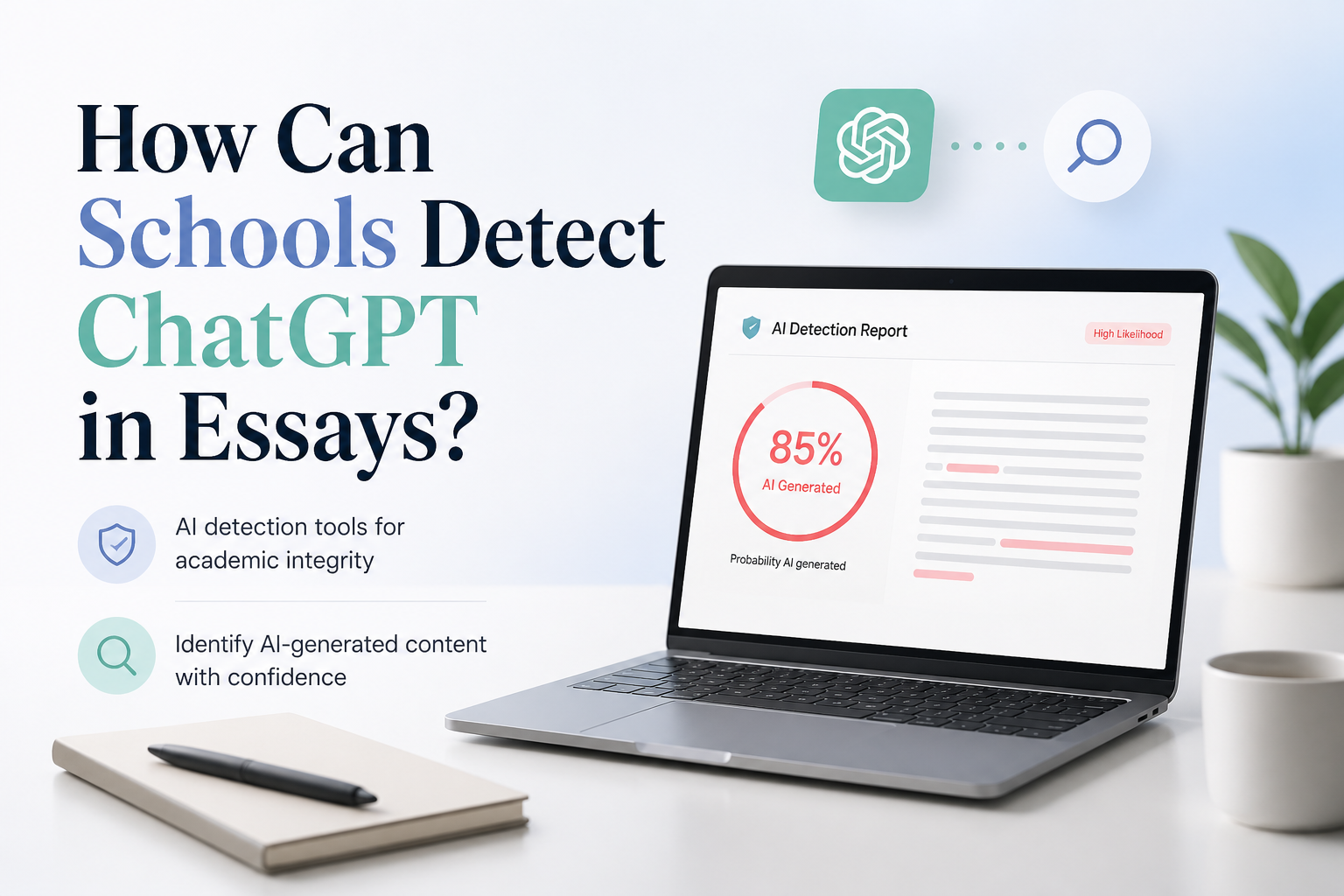
No single test can prove that ChatGPT wrote an essay. Schools get a fairer result by combining a detector signal with drafts, source checks, prior writing, plus a calm student conversation.
Start with Clever AI Detector as a screening tool, not a verdict. If an essay raises concerns, compare it with earlier work, inspect the drafting process, verify its sources, then let the student explain how the paper was produced.
Never punish a student from an AI score alone. Detectors can flag human writing, while edited AI text may escape detection. Keep a teacher in charge of every decision, follow school policy, plus document evidence that can be independently checked.
Screen an Essay for AI Patterns → Clever AI Detector
Browser-based first-pass screening · Reviews pasted text quickly · Best used alongside drafts, source checks, plus teacher judgment
Choose a Fair Method for Detecting ChatGPT in Essays
Begin with quick screening, then move toward evidence of the student’s actual writing process.
| Method | Best for | Time | Success rate |
|---|---|---|---|
| 1. Scan the Essay With Clever AI Detector TRY FIRST | Fast preliminary screening | ~2 min | ● 65% |
| 2. Compare the Essay With Earlier Writing | Finding major voice shifts | ~10 min | ● 80% |
| 3. Review the Essay’s Draft History | Checking authorship process | ~15 min | ● 90% |
| 4. Audit the Essay’s Sources and Claims | Research-based assignments | ~20 min | ● 85% |
| 5. Hold a Short Student Conference | Confirming subject understanding | ~8 min | ● 88% |
When Schools Should Not Rely on an AI Detector
Skip detector-led conclusions for very short responses, heavily quoted passages, formulaic lab reports, or work written by students still learning English. These texts may provide too little individual language for a useful comparison.
OpenAI says its own research did not find text detectors reliable enough for decisions with lasting consequences. Its public classifier was removed on July 20, 2023 due to low accuracy. Schools should use detector output only as one limited clue, then seek evidence from the writing process.
How a Fair ChatGPT Essay Review Might Work
Suppose a history teacher receives a polished essay from a student whose in-class writing is usually brief. A detector flags several paragraphs, but the teacher does not lower the grade. Instead, the teacher checks two earlier samples, reviews the document history, plus verifies three citations.
The student then explains that a tutor helped reorganize the draft, while a grammar tool corrected sentences. The version history supports that account. This process resolves the concern without pretending the detector knew who wrote the paper.
Top 5 Methods Schools Can Use to Detect ChatGPT in Essays
01 Scan the Essay With Clever AI Detector
Fastest for finding passages that deserve a closer human review
~2 min
Scan the Essay With Clever AI Detector
Fastest for finding passages that deserve a closer human review
Clever AI Detector offers a quick first pass when a teacher needs to screen a long essay. Treat its result as a reason to review specific passages, not proof that a student cheated.
- Open Clever AI Detector in a browser.
- Paste the essay into the detector without the student’s name, email, or other identifying details.
- Run the scan, then note the overall result plus any passages the tool marks as potentially AI-written.
- Read each marked passage in context. Look for abrupt shifts in vocabulary, reasoning, specificity, or voice.
- Save the result with a short note stating that it is a preliminary screening signal, not a disciplinary finding.
02 Compare the Essay With Earlier Writing
Best for spotting a sudden change in voice, skill, or subject knowledge
~10 min
Compare the Essay With Earlier Writing
Best for spotting a sudden change in voice, skill, or subject knowledge
A teacher who knows a student’s normal writing often has better context than a general-purpose classifier. The useful clues are meaningful changes, such as a new vocabulary level or a polished argument that the student cannot usually sustain.
- Choose two earlier samples written under reasonably controlled conditions, such as an in-class response.
- Compare sentence length, paragraph structure, vocabulary, punctuation, citation habits, plus common errors.
- Mark sharp changes rather than ordinary improvement. A stronger paper after feedback or extra time is not automatically suspicious.
- Check whether the new essay uses course concepts with the same depth shown in prior work.
- Record two or three concrete differences before asking the student about the draft.
03 Review the Essay’s Draft History
Strongest for checking how the student built the paper over time
~15 min
Review the Essay’s Draft History
Strongest for checking how the student built the paper over time
Process evidence is usually more useful than guessing from prose style. Notes, revisions, deleted sections, source collection, plus teacher feedback can show whether the essay developed through genuine work.
- Ask for the outline, research notes, rough drafts, plus the final document.
- Open the document’s version history if school policy permits this review.
- Look for a believable sequence of additions, cuts, reorganized paragraphs, citation fixes, plus wording changes.
- Notice whether most of the essay appeared in one large paste. Treat that as a question, since students also draft in other apps.
- Ask the student to explain where the draft was written if the history is thin or incomplete.
04 Audit the Essay’s Sources and Claims
Useful when the paper looks fluent but contains vague, invented, or mismatched evidence
~20 min
Audit the Essay’s Sources and Claims
Useful when the paper looks fluent but contains vague, invented, or mismatched evidence
AI-assisted papers may contain citations that do not exist, claims that the cited source never made, or details that sound precise without being verifiable. A source audit checks the academic work itself rather than relying on writing style.
- Select three to five important claims from different parts of the essay.
- Open the cited sources through the school library, publisher, journal, or another reliable location.
- Confirm that each source exists, includes the listed author or title, plus supports the nearby claim.
- Check quoted wording, page numbers, publication dates, URLs, plus citation format.
- Ask the student to show notes for any source that cannot be found or does not match the claim.
05 Hold a Short Student Conference
Best for testing ownership of the argument without turning the meeting into an interrogation
~8 min
Hold a Short Student Conference
Best for testing ownership of the argument without turning the meeting into an interrogation
A brief conversation can reveal whether the student understands the thesis, evidence, plus revision choices. It also gives the student space to disclose permitted AI help, tutoring, translation support, or another reasonable explanation.
- Choose one central argument, one source, plus one unusual phrase from the essay.
- Ask the student to summarize the thesis in everyday language.
- Invite the student to explain why a specific example was selected plus how it supports the claim.
- Ask what changed between the first draft plus the final version.
- Let the student describe any tools, people, or AI systems used during research, drafting, editing, or citation work.
- Compare the answers with the essay, draft record, assignment rules, plus any detector result.
The Fairest Way to Check an Essay for ChatGPT Use
Clever AI Detector is the quickest first move when a school needs to identify essays that may require added review. Its output should lead to questions, not an automatic penalty.
For a defensible decision, pair the scan with earlier writing, version history, verified sources, plus a short conference. The strongest conclusion comes from several pieces of consistent evidence tied to the school’s published AI policy.
Save an in-class writing sample near the start of each term so future comparisons rely on real student work rather than guesses about what human writing should sound like.