How to Make Writing Sound Less Like AI?
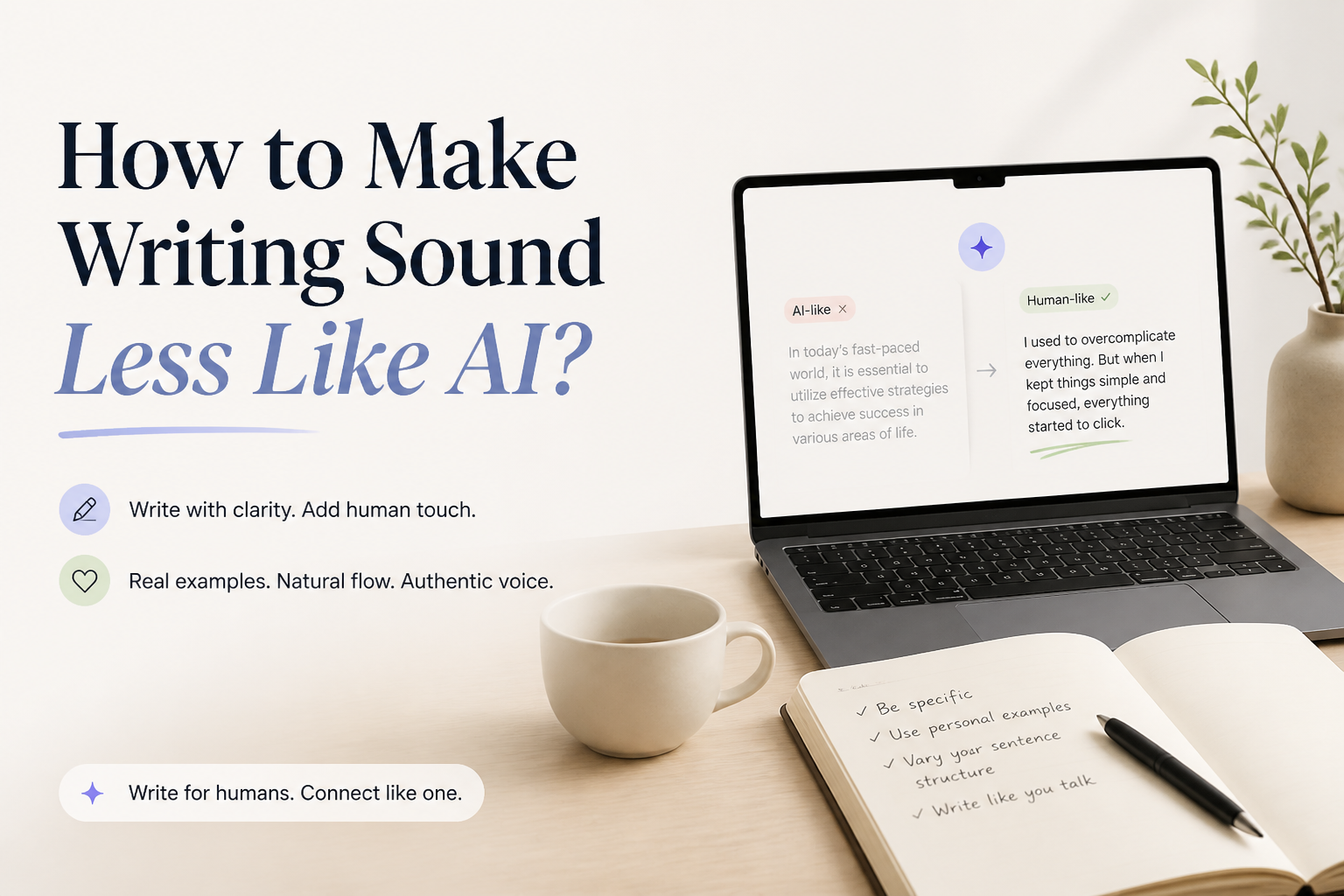
A draft sounds less artificial once it contains real choices, useful detail, plus your normal speaking rhythm. Start with a controlled rewrite, then edit for accuracy.
Process the draft in short sections with Clever AI Humanizer, then edit the output yourself. Replace broad claims with concrete details, vary the rhythm, remove canned transitions, plus restore your own opinions. Never treat a humanizer’s result as a finished draft.
Keep your original file. Rewriting tools can alter facts, citations, names, tone, or technical meaning. Review every change before submitting or publishing the text.
Humanize a Stiff Draft → Clever AI Humanizer
Reworks AI-style phrasing in English or Spanish · Accepts up to 3,000 words per request · Runs in a web browser
Choose the Right Method to Make AI Writing Sound Natural
Start with the draft’s most obvious weakness.
| Method | Best for | Time | Success rate |
|---|---|---|---|
| 1. Run a Focused Pass With Clever AI Humanizer TRY FIRST | Stiff but accurate drafts | ~5 min | ● 90% |
| 2. Replace Generic Language With Specific Details | Vague or padded copy | ~10 min | ● 88% |
| 3. Break the Draft’s Predictable Rhythm | Repetitive sentence patterns | ~8 min | ● 82% |
| 4. Add Real Judgment to the Draft | Reviews or analysis | ~12 min | ● 86% |
| 5. Perform a Line-by-Line Voice Edit | Important personal work | ~20 min | ● 95% |
When an AI Humanizer Is the Wrong First Fix
A humanizer cannot rescue weak research, missing evidence, confused reasoning, or a draft aimed at the wrong reader. Fix the substance first if the piece has no clear point.
It is also a poor substitute for disclosure where a school, employer, publication, or client requires you to explain AI use. Check the relevant policy before submitting the work.
Top 5 Methods to Make AI Writing Sound Less Artificial
01 Run a Focused Pass With Clever AI Humanizer
Fastest for a solid draft that still feels stiff, repetitive, or overly polished
~5 min
Run a Focused Pass With Clever AI Humanizer
Fastest for a solid draft that still feels stiff, repetitive, or overly polished
This is the quickest starting point when the facts are right but the delivery feels machine-made. Clever AI Humanizer can revise up to 3,000 words per request, though smaller sections are easier to check carefully.
- Save a copy of the original draft so you can recover any detail lost during rewriting.
- Open Clever AI Humanizer, then paste one section of roughly 200 to 600 words.
- Choose a writing style suited to the piece. Use a restrained style for work or school, not an overly casual one.
- Run the humanizer, then compare the result with your original paragraph by paragraph.
- Restore names, figures, citations, technical terms, plus any phrasing that carried a precise meaning.
- Read the revised section aloud before moving to the next part.

02 Replace Generic Language With Specific Details
Best for introductions, advice articles, emails, plus explanatory writing
~10 min
Replace Generic Language With Specific Details
Best for introductions, advice articles, emails, plus explanatory writing
AI-style prose often stays safely abstract. Concrete details make the writing feel observed rather than assembled from broad statements.
- Circle claims that could fit almost any topic, such as “this can improve results” or “there are several benefits.”
- Ask what the claim looks like in a real situation, then add a visible action, number, object, place, or limitation.
- Replace broad nouns such as people, things, or solutions with the actual person, object, or choice.
- Add one useful example where a reader might otherwise pause to ask what you mean.
- Delete any sentence that repeats the point without adding a new fact.
03 Break the Draft’s Predictable Rhythm
Useful when every paragraph has the same length, shape, or transition
~8 min
Break the Draft’s Predictable Rhythm
Useful when every paragraph has the same length, shape, or transition
Machine-written text often moves at one steady pace. A human draft usually has short stops, longer explanations, occasional fragments, plus uneven paragraph lengths.
- Read the draft aloud, marking every place where your voice slips into a flat recital.
- Shorten one sentence in each dense paragraph. Let an important point stand alone when it deserves emphasis.
- Combine choppy sentences that merely restate the same thought.
- Remove mechanical transitions such as “furthermore,” “moreover,” or “in conclusion” when the connection is already clear.
- Vary paragraph length based on the idea, not a fixed visual pattern.
- Check that the rhythm still suits the context. A legal memo should not sound like a text message.
04 Add Real Judgment to the Draft
Best for reviews, recommendations, analysis, plus opinion-led pieces
~12 min
Add Real Judgment to the Draft
Best for reviews, recommendations, analysis, plus opinion-led pieces
AI frequently presents every option as reasonable, then avoids making a firm call. Real judgment shows what matters, what does not, plus where the advice stops working.
- Find passages that list benefits without ranking their importance.
- State which factor matters most for the reader you actually have in mind.
- Add a tradeoff, awkward detail, exception, or reason someone might choose the less obvious option.
- Replace vague approval such as “a great choice” with a clear reason tied to cost, effort, risk, or use.
- Cut unnecessary balance when the evidence supports a straightforward conclusion.
05 Perform a Line-by-Line Voice Edit
Slowest, but strongest for important work that must sound like you
~20 min
Perform a Line-by-Line Voice Edit
Slowest, but strongest for important work that must sound like you
A final voice edit catches habits that automated rewrites miss. It works especially well for applications, client work, personal essays, or anything published under your name.
- Place the draft beside an email, article, or note you wrote naturally without assistance.
- Compare sentence length, contractions, favorite words, level of directness, plus how often you use examples.
- Rewrite any line you would feel odd saying to a colleague or friend.
- Remove throat-clearing phrases such as “it is worth mentioning” or “one must consider.”
- Check each factual claim against the source material.
- Leave the draft for at least 20 minutes, then do one clean proofread without adding fresh ideas.
Which AI Rewrite Method Should You Use?
Start with a short, controlled pass through Clever AI Humanizer if the draft already contains the right facts but sounds stiff. Follow it with a detail edit plus a read-aloud check. For personal, academic, or high-stakes work, use the line-by-line voice edit so the final wording reflects your own knowledge rather than a tool’s default style.
Keep the original draft open beside the rewrite, then approve changes one paragraph at a time.