Best RAID Recovery Software for Advanced Users
These tools cover everything from image-first recovery to manual parity layouts. Disk Drill is the easiest place to start, though difficult proprietary arrays may call for a more surgical option.
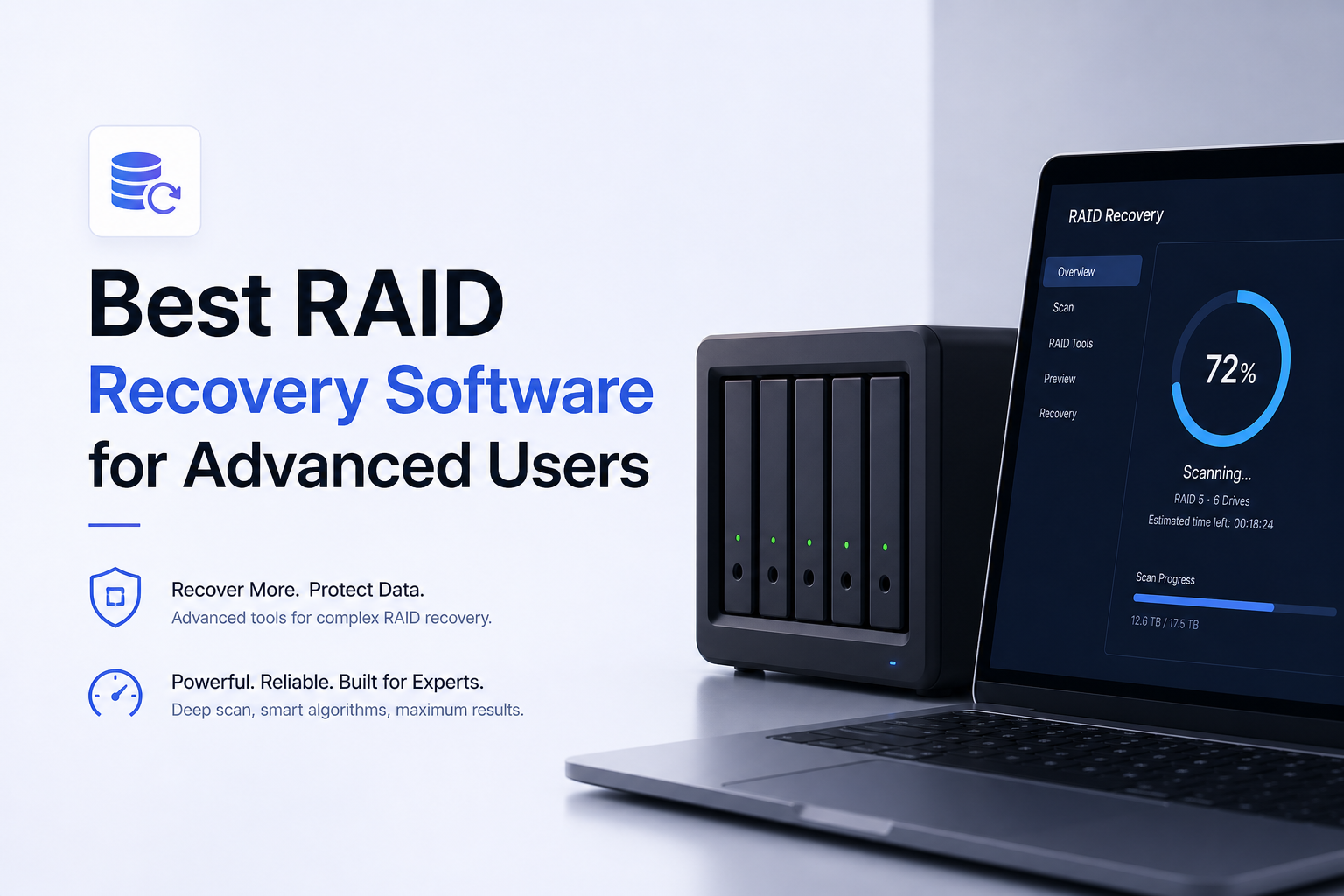
Disk Drill is our best overall RAID recovery pick for advanced users who want image-first scanning without wrestling with a forensic-style interface. Choose UFS Explorer for proprietary NAS layouts or R-Studio when manual parity control matters more than convenience.
Disk Drill
9.0/10Best for: Advanced operators who want capable Linux RAID scanning without a dense reconstruction interface
- Clean workflow for large result sets
- Byte-to-byte disk image creation
- Supports Linux RAID sources plus virtual disks
- Useful file previews with recovery-chance indicators
UFS Explorer RAID Recovery
8.9/10Best for: Storage specialists handling Synology SHR, Drobo BeyondRAID, RAID-Z, Btrfs RAID, or damaged NAS metadata
- Excellent standard plus proprietary RAID coverage
- Manual RAID Builder with saved configurations
- Adaptive processing for bad-sector maps
- Perpetual personal license
R-Studio
8.7/10Best for: Engineers who need custom block order, parity delay, nested arrays, or parameter-level inspection
- Detailed manual RAID controls
- Automatic RAID parameter detection
- Hex editor plus consistency checking
- Multi-pass imaging with sector maps
Best RAID Recovery Software for Advanced Users Compared
This table compares manual array construction, image support, license price, plus our overall score. Capability labels reflect documented features, while scores are editorial judgments explained in the individual reviews below.
| Tool | Manual RAID Build | Disk Images | Price | Score |
|---|---|---|---|---|
| 1. Disk Drill PICK | ● No | ● Yes | $89 one-time | 9.0/10 |
| 2. UFS Explorer RAID Recovery | ● Yes | ● Yes | $149.95 one-time | 8.9/10 |
| 3. R-Studio | ● Yes | ● Yes | $79.99 one-time | 8.7/10 |
| 4. DMDE | ● Yes | ● Yes | $48 one-time | 8.4/10 |
| 5. ReclaiMe File Recovery | ● Yes | ● Yes | $189.95 one-time | 8.1/10 |
The 5 Best RAID Recovery Software Tools for Advanced Users, Reviewed
01 Disk Drill
Windows, macOS / CleverFiles
9.0/10
Disk Drill
Windows, macOS / CleverFiles
Disk Drill earned first place because it makes a cautious RAID workflow unusually manageable. It recognizes Linux RAID sources, virtual disks, plus disk images, while its byte-to-byte backup tool lets you work from copies rather than repeatedly reading original media.
During our feature check, the strongest sequence was image first, scan second, preview third. Preview filters made it practical to inspect several file families before committing to recovery. Windows Basic can restore up to 100 MB free, while the Mac edition mainly uses its free tier for scanning plus previews.
The tradeoff matters. Disk Drill is not the best choice for manually defining an undocumented RAID 6 parity rotation. UFS Explorer or R-Studio gives a storage engineer more control there. Disk Drill wins for advanced users whose array is already exposed, recognized through Linux RAID metadata, or available as member images.
Best forAdvanced operators who want capable Linux RAID scanning without a dense reconstruction interface
- Clean workflow for large result sets
- Byte-to-byte disk image creation
- Supports Linux RAID sources plus virtual disks
- Useful file previews with recovery-chance indicators
- One PRO license covers Windows plus macOS
- No full manual RAID builder for obscure layouts
- Mac Basic usually requires payment to save ordinary recovered files
- Lifetime pricing may cost more than DMDE

02 UFS Explorer RAID Recovery
Windows, macOS, Linux / SysDev Laboratories
8.9/10
UFS Explorer RAID Recovery
Windows, macOS, Linux / SysDev Laboratories
UFS Explorer RAID Recovery has the deepest storage-specific toolkit in this shortlist. It detects standard RAID metadata, recognizes layouts from 50-plus NAS vendors, plus provides an interactive builder when the original configuration is gone.
Its coverage includes RAID 0, 1, 5, 6, 10, 50, nested arrays, Synology SHR, Drobo BeyondRAID, Btrfs RAID, RAID-Z, plus LVM Thin Provisioning. The trial permits full assembly, scanning, imaging, plus previews, though saved files are capped at 768 KB each.
Best forStorage specialists handling Synology SHR, Drobo BeyondRAID, RAID-Z, Btrfs RAID, or damaged NAS metadata
- Excellent standard plus proprietary RAID coverage
- Manual RAID Builder with saved configurations
- Adaptive processing for bad-sector maps
- Perpetual personal license
- Runs on Windows, macOS, plus Linux
- Interface assumes storage knowledge
- License is sold per operating-system platform
- Costs more than R-Studio or DMDE
03 R-Studio
Windows, macOS, Linux / R-Tools Technology
8.7/10
R-Studio
Windows, macOS, Linux / R-Tools Technology
R-Studio is the pick for operators who want to define the array rather than trust automatic detection. Its virtual RAID module handles common levels, nested sets, parity delays, reverse RAIDs, plus custom descriptions. A consistency check helps catch a wrong disk order before a long scan.
The demo recovers files smaller than 1,024 KB, which is enough to verify documents or thumbnails. The standard license costs $79.99 for one host platform. Keys are platform-specific, so a mixed Windows, Mac, plus Linux bench needs careful licensing.
Best forEngineers who need custom block order, parity delay, nested arrays, or parameter-level inspection
- Detailed manual RAID controls
- Automatic RAID parameter detection
- Hex editor plus consistency checking
- Multi-pass imaging with sector maps
- Strong file-system coverage
- Busy interface takes time to learn
- Standard keys do not transfer between operating systems
- Technician licensing is expensive
04 DMDE
Windows, macOS, Linux, DOS / DMDE Software
8.4/10
DMDE
Windows, macOS, Linux, DOS / DMDE Software
DMDE packs partition recovery, disk editing, imaging, RAID construction, plus file recovery into a small utility. It is less guided than Disk Drill, though experienced users may prefer the direct access to offsets, sectors, partitions, plus virtual volumes.
The free edition is unusually useful. It can restore up to 4,000 files from the active directory per request. Standard costs $48 as a perpetual one-OS-family license, while Professional adds portable activation, E01 reading, copy logs, reports, plus commercial recovery rights.
Best forHands-on users comfortable with raw partitions, hex views, disk editing, plus manual volume construction
- Low perpetual price
- Capable manual disk plus volume tools
- Generous directory-based free recovery
- Runs on several desktop platforms plus DOS
- Professional edition supports portable use
- Technical interface is easy to misuse
- Workflow feels less visual than Disk Drill
- Some imaging features require Professional
05 ReclaiMe File Recovery
Windows / ReclaiMe Data Recovery
8.1/10
ReclaiMe File Recovery
Windows / ReclaiMe Data Recovery
ReclaiMe separates RAID parameter discovery from file recovery. The free RAID utility can identify start offset, block size, disk order, plus RAID 5 parity behavior, then pass that layout to ReclaiMe File Recovery or save it for use elsewhere.
That approach is handy when metadata is missing but you do not want to calculate every parameter manually. Ultimate costs $189.95 for a lifetime license covering Windows, Linux, Mac, plus NAS file systems. The software itself runs on Windows, plus license activation requires an internet connection.
Best forWindows users who need help identifying disk order, stripe size, offset, or RAID 5 parity rotation
- Free RAID parameter discovery utility
- Works with physical members or disk images
- Can export the discovered layout
- Ultimate covers NAS plus broad file systems
- Preview available before purchase
- Windows host required
- Internet connection required for licensed use
- RAID 6 coverage is less clearly documented than rival tools
How We Evaluated RAID Recovery Software for Advanced Users
We compared documented RAID-level coverage, manual reconstruction controls, image handling, file-system support, preview limits, host platforms, plus licensing. We also checked whether each tool encourages an image-first workflow, since repeated direct scans can add stress to marginal drives.
Scores favor useful control without needless friction. No synthetic recovery percentage appears here because results change with overwrite activity, failed members, controller metadata, stripe geometry, plus file-system damage. Instead, we verified whether each trial could expose folders or preview files before payment.
How to Choose RAID Recovery Software for a Complex Array
Start with the storage layout. An intact mdadm array with deleted files needs a different tool from a four-disk RAID 5 whose controller died. Disk Drill fits recognized arrays or member images. UFS Explorer fits proprietary NAS layouts. R-Studio fits custom stripe or parity definitions. DMDE suits operators who already think in sectors plus offsets.
Check the destination capacity too. Recovery needs separate healthy storage large enough for the files, plus additional space if you plan to image every member. A four-drive set can require far more temporary capacity than the final used-data total suggests.
Common Advanced RAID Recovery Mistakes to Avoid
The worst mistake is accepting a controller's initialize, repair, import, or rebuild suggestion before preserving every member. A rebuild can write parity across sectors that still contain recoverable metadata. Another common error is guessing disk order from bay numbers after the drives have been moved.
Label each disk, record serial numbers, keep the original order, plus work from images whenever possible. If two members show physical trouble, stop. Software can reconstruct logical damage, but it cannot safely repair heads, motors, firmware faults, or unstable media.
Our Verdict on Advanced RAID Recovery Software
Disk Drill takes first place because it keeps image creation, scanning, filtering, previews, plus recovery in one understandable workflow. UFS Explorer is the stronger specialist choice for proprietary NAS structures, while R-Studio suits custom parity work. DMDE offers remarkable value, with ReclaiMe filling a useful parameter-discovery niche.Image every readable member first, preserve the original disk order, then test the same small folder in two tools before paying or starting a full extraction.