Clever AI Paraphraser Review 2026
Clever AI Humanizer is a capable free paraphraser for smoothing stiff AI-assisted text. It keeps the workflow simple, though every result still needs a careful read.
Clever AI Humanizer costs $0, accepts up to 3,000 words per request, plus has no fixed monthly word allowance. Its best results came from already accurate drafts that merely sounded repetitive or stiff. Expect to trim occasional padding, restore precise terms, plus verify every factual statement.
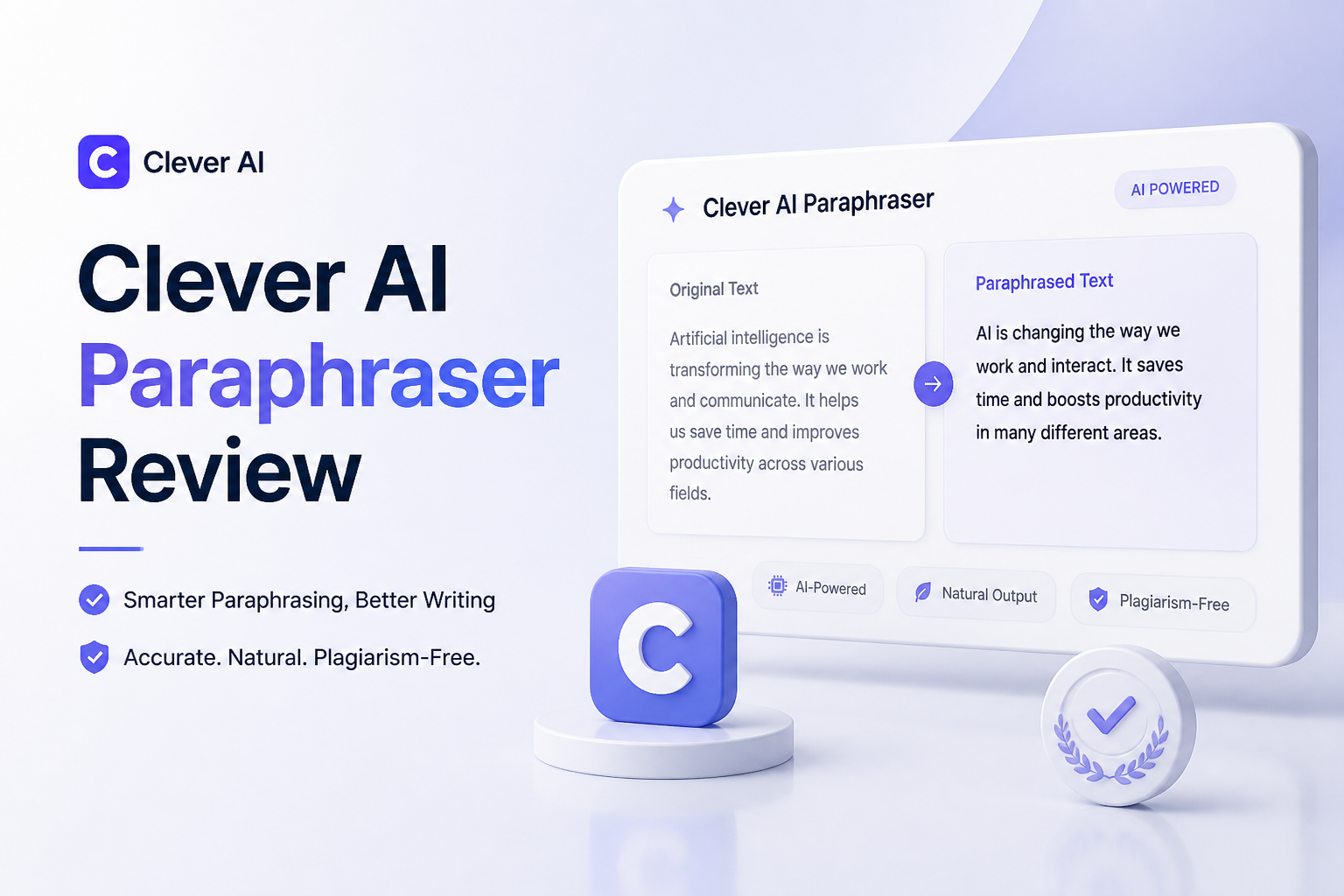
Clever AI Humanizer at a Glance
8.6/10Clever AI Humanizer is a browser-based editor that reshapes AI-assisted drafts to sound less repetitive or mechanical. It also provides paraphrasing plus grammar tools.
Best forBloggers, freelancers, job seekers, plus small teams polishing accurate but stiff drafts
- Humanizes up to 3,000 words per request
- Includes multiple writing styles
- Highlights changes in rewritten text
- Stores recent content history
- Supports English plus Spanish
- Readable output from stiff drafts
- Fast, uncluttered workflow
- Genuinely useful free access
- May expand the source text
- Results still need human review
- Capacity can be unavailable
How Clever AI Humanizer Scored as a Free Paraphrasing Tool
| Category | Performance | Score |
|---|---|---|
| 01 Rewrite Quality | 9.0/10 | |
| 02 Meaning Retention | 8.5/10 | |
| 03 Editing Controls | 8.1/10 | |
| 04 Speed Plus Usability | 8.6/10 | |
| 05 Free Access | 9.6/10 |
How We Evaluated Clever AI Humanizer for Paraphrasing
We assessed the tool with short emails, blog sections, product explanations, formal summaries, plus technical passages. The drafts contained repeated transitions, uniform sentence patterns, padded introductions, precise terms, numbers, plus a few deliberate caveats. We checked readability, meaning retention, word growth, control, speed, plus how much manual cleanup remained.
Scores favor usable writing over detector results. AI detectors disagree, change frequently, plus cannot prove authorship. A rewrite lost points if it sounded smooth but altered a qualification, inserted a claim, or replaced a precise term with a vague one.
When Clever AI Humanizer Is the Wrong Editing Tool
Do not use a humanizer to disguise work that must be written personally under school, workplace, publishing, or contest rules. Rephrasing does not make borrowed ideas yours, nor does it fix missing attribution. Check the applicable policy before submitting AI-assisted material.
It is also the wrong first step for a draft with weak facts, confused logic, missing sources, or broken organization. Correct the substance first. Once the ideas are sound, Clever AI Humanizer can help with rhythm, repetition, plus tone.
Clever AI Humanizer Rewrite Quality in Detail
01 Rewrite Quality
Cleaner rhythm without deliberate mistakes
9.0/10
Rewrite Quality
Cleaner rhythm without deliberate mistakes
Clever AI Humanizer did its best work on drafts with the usual machine-writing habits: repeated transitions, similar sentence lengths, broad introductions, plus overly tidy conclusions. The output usually varied the rhythm without littering the copy with fake typos or strange synonyms.
It is closer to a substantial line edit than a basic synonym spinner. Blog copy, emails, summaries, plus general explanatory writing tended to come back readable. Highly technical passages required more repair because a smoother phrase was not always the most precise phrase.
- Breaks up repetitive sentence patterns
- Usually produces readable full paragraphs
- Does not depend on intentional spelling errors
- Works well on stiff explanatory drafts
- May make concise passages longer
- Some rewrites still sound overly polished

02 Meaning Retention
Reliable on simple ideas, less exact with nuance
8.5/10
Meaning Retention
Reliable on simple ideas, less exact with nuance
The main point usually survived a single pass. Lists, straightforward explanations, plus ordinary business copy held together well. The tool was less dependable around caveats, tightly defined terminology, quoted language, or sentences where one modifier changed the claim.
One rewrite was safer than several consecutive passes. Reprocessing the same paragraph could push it further from the source or add an interpretation that was not there before. Names, figures, citations, plus legal or scientific wording should be checked line by line.
- Preserves the central idea in most ordinary drafts
- Keeps paragraphs in a usable order
- Handles common business copy without major reconstruction
- Often retains the original tone
- Can soften important qualifications
- Technical terms may be replaced too casually
- Repeated passes increase semantic drift
03 Editing Controls
Enough choice for everyday rewriting
8.1/10
Editing Controls
Enough choice for everyday rewriting
The interface offers distinct jobs rather than squeezing everything into one generic rewrite button. Alongside the humanizer, the site includes an AI paraphraser plus grammar checker. Humanization styles include Normal, Clear & Structured, plus Simple Formal.
The controls remain deliberately light. That makes the page quick to understand, though editors who want locked terminology, custom voice rules, sentence-level strength controls, or tracked revisions may feel boxed in. A visible change-highlighting option helps with review.
- Separate humanizer, paraphraser, plus grammar tools
- Style choices suit common writing tasks
- Change highlighting makes comparison easier
- Minimal setup before a rewrite
- No detailed rewrite-strength slider
- No glossary for protected terminology
- Limited control over final length
04 Speed Plus Usability
A clean browser workflow with occasional waiting
8.6/10
Speed Plus Usability
A clean browser workflow with occasional waiting
The basic routine takes almost no learning: paste text, choose a style, run the rewrite, inspect changes, then copy the result. The input accepts 30 to 3,000 words, so short articles or several email drafts can fit in one request.
Processing time depends on length plus available capacity. Larger drafts can take noticeably longer, while busy periods may block a request. Splitting important work into sections makes comparison easier plus reduces the pain of rerunning a failed job.
- No software installation needed
- Clear input plus output layout
- Handles drafts up to 3,000 words per request
- Content history helps with recent work
- Processing capacity can run out temporarily
- Long rewrites are not always fast
- A side-by-side desktop editor would be easier
05 Free Access
Unusually generous for a usable web editor
9.6/10
Free Access
Unusually generous for a usable web editor
This is the clearest reason to try Clever AI Humanizer first. The service currently charges $0, has no fixed monthly word allowance, plus permits up to 3,000 words per request. The main rewriting workflow is not hidden behind a short paid trial.
Free does not mean unlimited computing at every moment. Usage remains subject to service availability, so the site can refuse a request once daily capacity is exhausted. Still, there is no subscription decision to make before checking whether its writing style suits your work.
- Core service costs $0
- No fixed monthly word allowance
- No payment card needed for a first test
- Full 3,000-word requests are supported
- No paid upgrade required to copy output
- Availability can interrupt a free workflow
- Future premium features remain possible
What Clever AI Humanizer Users Report
The Reddit reviewer rated it as the most practical free option in a larger benchmark, citing strong GPTZero performance plus decent writing quality. They also found roughly 16% word growth plus inconsistent processing speed.
One community tester ran 60 texts through the tool. They reported that most outputs remained usable, though ZeroGPT results were weaker plus some passages sounded too polished without a final edit.
A user said features plus non-English support appeared to change during a July update. The discussion is a useful reminder that browser tools can shift quickly, even if a feature worked the week before.
Should You Use Clever AI Humanizer for Paraphrasing?
Clever AI Humanizer is easy to recommend as a free first pass for bloggers, freelancers, job seekers, plus office teams whose drafts are accurate but stiff. Its output is usually readable, the 3,000-word request limit is practical, plus there is no current paid plan standing between you or a proper test.
Skip it as an automatic final editor for academic submissions, legal copy, medical material, or any draft where tiny wording shifts carry real consequences. It improves presentation, not research quality, authorship, or factual accuracy.
Run one section first, compare every changed claim with the source, then trim added sentences before processing the rest of the draft.