How to Reduce AI Detection Score in Writing in 2026?
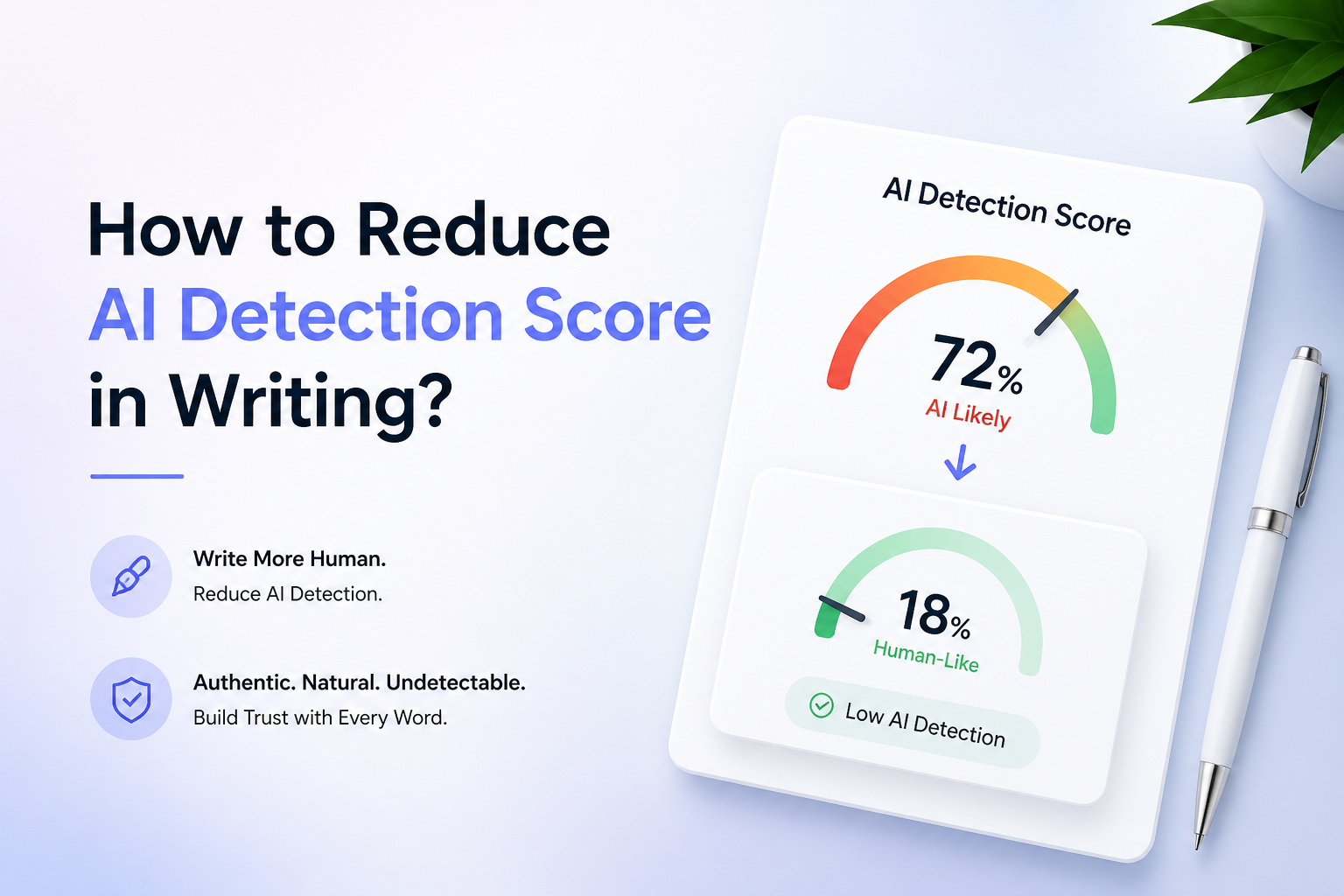
A high detector score is not proof of AI use. These five methods focus on authentic revision, clearer prose, plus careful tool use without wrecking the meaning.
Start by revising the text in your own voice, not by chasing a perfect zero. For a fast first pass, process short sections with Clever AI Humanizer, then manually restore facts, citations, tone, plus phrasing that sounds like you.
No tool can guarantee a low score across every detector. Follow school, publisher, client, or workplace rules. Do not use rewriting tools to hide prohibited assistance, fabricated research, plagiarism, or work you did not create.
Humanize a Stiff Draft → Clever AI Humanizer
Processes up to 3,000 words per request · Supports English plus Spanish · Includes change highlighting for easier review
Top 5 Methods to Reduce an AI Detection Score
01 Run a Focused Pass With Clever AI Humanizer
Fastest for a solid draft that still sounds uniform or mechanical
~5 min
Run a Focused Pass With Clever AI Humanizer
Fastest for a solid draft that still sounds uniform or mechanical
Clever AI Humanizer can soften repeated sentence patterns without requiring a line-by-line rewrite. Treat its result as an editable draft, not a guaranteed detector bypass.
- Save a copy of the original so you can restore any facts, citations, or useful wording that gets changed.
- Open Clever AI Humanizer, then paste one section containing at least 30 words.
- Choose the writing style that best fits the piece. Start with the normal option if you are unsure.
- Run the humanizer, then compare the result against the original with change highlighting enabled.
- Restore altered facts, technical terms, quotations, plus any wording that no longer sounds like you.
- Read the revised section aloud before keeping it.

02 Rebuild the Draft From a Plain Outline
Best when the original follows a predictable AI-style structure
~20 min
Rebuild the Draft From a Plain Outline
Best when the original follows a predictable AI-style structure
A detector score often falls after genuine authorship enters the draft. Rebuilding from notes removes canned transitions, symmetrical paragraphs, plus wording you would never choose yourself.
- Reduce each paragraph to one factual bullet in a separate document.
- Close the original draft so you are not tempted to paraphrase it sentence by sentence.
- Write each section from the bullets using your normal vocabulary.
- Vary paragraph length according to the idea rather than forcing every section into the same shape.
- Add one concrete detail, example, limitation, or observation wherever it improves the point.
- Compare the rewrite with the source material to confirm every claim remains accurate.
03 Break Repetitive Sentence Patterns
Useful when the content is accurate but every paragraph has the same rhythm
~12 min
Break Repetitive Sentence Patterns
Useful when the content is accurate but every paragraph has the same rhythm
AI-style prose often repeats the same sentence length, transition placement, or claim-explanation-summary pattern. A rhythm edit makes the text less predictable while improving readability.
- Highlight repeated openings such as
Additionally,Furthermore, orIn conclusion. - Delete transitions that do not carry real meaning.
- Combine two choppy sentences where the ideas belong together.
- Split long sentences that contain several separate claims.
- Replace repeated paragraph templates with a mix of examples, direct statements, questions, or brief qualifications.
- Read only the first sentence of each paragraph to check whether the openings still sound alike.
04 Add Specific Evidence From Your Own Work
Strongest for reports, reviews, case studies, plus experience-based writing
~15 min
Add Specific Evidence From Your Own Work
Strongest for reports, reviews, case studies, plus experience-based writing
Generic explanations are easy to produce at scale. Real measurements, choices, objections, failed attempts, plus source-specific details give a draft a less generic shape.
- Mark broad claims that could appear in almost any article on the subject.
- Replace each weak claim with a sourced fact, observed result, precise example, or clear limitation.
- Explain why one detail matters instead of dropping it into the paragraph without context.
- Describe a tradeoff you actually faced, such as time versus accuracy or cost versus convenience.
- Cite outside material according to the required style.
- Remove any personal detail that cannot be verified or that you did not truly experience.
05 Review the Draft in Small Sections
Best for finding isolated passages that trigger an unusually high score
~10 min
Review the Draft in Small Sections
Best for finding isolated passages that trigger an unusually high score
A whole-document score does not show which passage caused the result. Testing small sections can locate repetitive areas, though detector outputs should be treated as rough signals rather than proof.
- Divide the draft into sections of roughly 150 to 300 words.
- Check each section with the same detector if testing is permitted by your school, client, or employer.
- Record the score instead of repeatedly changing passages at random.
- Review the highest-scoring section for generic wording, repeated syntax, vague claims, or abrupt transitions.
- Rewrite that section for clarity using your own notes plus source material.
- Run one final check, then stop once the prose is accurate, natural, plus consistent with your voice.
When Not to Use an AI Humanizer on a Draft
Skip a humanizer if the rules forbid outside rewriting tools, the document contains confidential material, or the draft has major factual gaps. A surface rewrite cannot repair unsupported claims, missing citations, copied passages, or weak reasoning.
It is also the wrong first move when the text does not represent your knowledge. Build the argument from your own notes before polishing its style.
Why Human-Written Text Can Receive a High AI Score
Formal wording, repeated sentence structures, short factual paragraphs, plus predictable transitions can raise a detector score even when a person wrote every line. Technical documentation, multilingual writing, edited academic prose, plus template-based business content may be especially vulnerable.
Keep dated drafts, notes, revision history, source files, plus version records when authorship could be questioned. That evidence is usually more meaningful than a screenshot from another detector.
Choose a Method to Reduce an AI Detection Score
Pick the method that matches what is wrong with the current draft.
| Method | Best for | Time | Success rate |
|---|---|---|---|
| 1. Run a Focused Pass With Clever AI Humanizer TRY FIRST | Stiff but accurate drafts | ~5 min | ● 82% |
| 2. Rebuild the Draft From a Plain Outline | Formulaic full drafts | ~20 min | ● 90% |
| 3. Break Repetitive Sentence Patterns | Uniform rhythm | ~12 min | ● 76% |
| 4. Add Specific Evidence From Your Own Work | Generic or vague passages | ~15 min | ● 87% |
| 5. Review the Draft in Small Sections | Locating flagged passages | ~10 min | ● 68% |
Which AI Detection Revision Method Should You Use?
Use Clever AI Humanizer as a first pass when the draft is accurate but noticeably stiff. Rebuild from an outline if the entire piece feels formulaic. For a mostly solid document, edit repeated rhythms, insert genuine evidence, then inspect short sections instead of endlessly rewriting the whole file.
The real target is credible writing that reflects your knowledge, sources, plus natural voice. A detector score is secondary.
Keep the original beside every rewrite, verify each factual change, then stop editing once the work sounds natural plus remains fully accurate.