How to Make AI Writing Sound Human from Start in 2026?
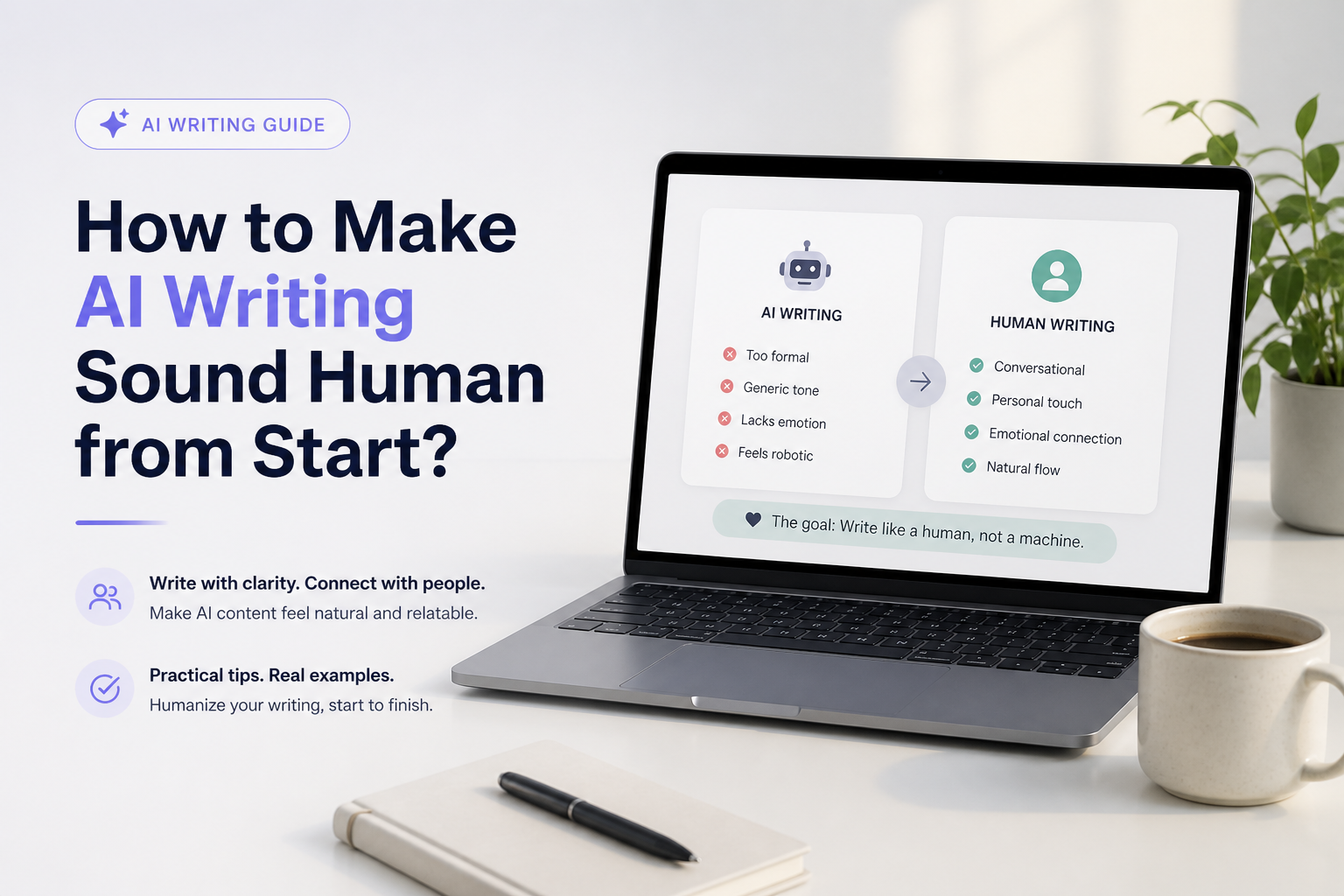
Natural writing starts before the cleanup pass. These five methods help you build voice, useful detail, plus uneven human rhythm into the draft from the beginning.
Start with facts plus a small voice guide, then draft in short sections. Clever AI Humanizer offers the quickest first pass, but the result still needs a meaning check plus a read-aloud edit.
Do not use humanizing tools to hide misconduct or misrepresent authorship. Follow your school, employer, publisher, or client rules on AI use. AI detectors can also produce inconsistent results, so a detector score is not proof of authorship.
Create a Natural First Draft → Clever AI Humanizer
Generates or revises text in one browser-based workflow · Useful for blogs, emails, essays, plus other everyday drafts
When an AI Humanizer Is the Wrong First Step
Do not humanize a draft that is factually weak, copied too closely from a source, or missing the writer’s actual point. Rewriting can make bad material smoother without making it accurate.
Fix the research plus reasoning first. Use a humanizer only after the draft says something worth keeping.
Choose a Method for More Human-Sounding AI Writing
Start with the first method that matches where your draft currently gets stuck.
| Method | Best for | Time | Success rate |
|---|---|---|---|
| 1. Draft with Clever AI Humanizer TRY FIRST | A fast, editable first draft | ~5 min | ● 88% |
| 2. Build a Small Voice Sheet | Keeping a consistent personal voice | ~10 min | ● 84% |
| 3. Outline with Real Details | Removing generic filler | ~8 min | ● 92% |
| 4. Write in Short Passes | Long articles or reports | ~15 min | ● 86% |
| 5. Edit the Draft Aloud | Final rhythm plus clarity checks | ~12 min | ● 95% |
Top 5 Methods to Make AI Writing Sound Human from the Start
01 Draft with Clever AI Humanizer
Fastest for creating a usable first version without the usual stiff AI tone
~5 min
Draft with Clever AI Humanizer
Fastest for creating a usable first version without the usual stiff AI tone
Clever AI Humanizer can produce or revise a first draft while you still have room to shape its voice. Give it concrete facts, then treat the result as editable material rather than finished copy.
- Write down the point, audience, required facts, plus anything the piece must not claim.
- Create a short first draft in Clever AI Humanizer instead of generating a long article all at once.
- Choose a style suited to the reader, such as casual for a personal blog or simple academic for a class draft.
- Read the output beside your notes, then restore any fact, qualification, or example that changed.
- Replace the opening plus closing with wording you would naturally say out loud.
- Save the clean draft, then do one final proofread without using another automatic rewrite.

02 Build a Small Voice Sheet
Best for keeping your natural habits visible from the first paragraph
~10 min
Build a Small Voice Sheet
Best for keeping your natural habits visible from the first paragraph
A voice sheet is a short list of habits pulled from writing you already like. It gives the draft real boundaries, which works better than asking for something vague like “more human.”
- Collect two short pieces you wrote without AI help, preferably for a similar audience.
- Mark recurring habits such as short openings, dry humor, plain verbs, contractions, or direct questions.
- List three habits to keep plus three habits to avoid.
- Draft the new piece while checking the list after every two or three paragraphs.
- Remove any phrase that sounds borrowed from a business memo, school rubric, or generic blog introduction.
03 Outline with Real Details
Strongest for preventing generic filler before it enters the draft
~8 min
Outline with Real Details
Strongest for preventing generic filler before it enters the draft
Human-sounding writing usually contains choices, limits, plus details that could not fit every other article. Put those details in the outline before drafting, not as decoration afterward.
- Write one practical question the piece must answer.
- Add three to five points based on facts, firsthand observations, source notes, or specific examples.
- Attach one concrete detail to each point, such as a price range, awkward step, exception, or small consequence.
- Put the points in the order a reader would need them rather than the neatest symmetrical order.
- Draft one section at a time, stopping when the section has answered its assigned question.
- Delete any paragraph that merely repeats the heading in longer words.
04 Write in Short Passes
Useful when long AI generations become repetitive or lose the original point
~15 min
Write in Short Passes
Useful when long AI generations become repetitive or lose the original point
Generating a whole piece in one shot often produces repeated transitions plus tidy, predictable sections. Working in short passes makes it easier to change pace or catch a weak claim early.
- Split the outline into sections of roughly two to four paragraphs.
- Draft only the first section, then check its purpose before moving forward.
- Vary the next section’s shape by using a brief example, a list, a counterpoint, or a direct explanation.
- Remove repeated setup lines such as reminders of what the article is about.
- Read the last sentence of one section beside the first sentence of the next, then fix abrupt or mechanical joins.
- Combine the sections only after each one works on its own.
05 Edit the Draft Aloud
Best final check for robotic rhythm, inflated wording, plus hidden repetition
~12 min
Edit the Draft Aloud
Best final check for robotic rhythm, inflated wording, plus hidden repetition
Reading aloud exposes phrases that look acceptable on screen but feel unnatural in speech. The goal is not to make every article conversational. It is to find spots where the wording fights the meaning.
- Read the draft aloud at a normal pace without correcting it mid-sentence.
- Mark every place where you stumble, run out of breath, or forget what the sentence is doing.
- Split overloaded sentences, then replace abstract phrases with direct verbs.
- Cut repeated conclusions, stacked adjectives, plus transitions that explain an obvious connection.
- Check every example, number, name, quotation, plus link against the original source.
- Read the revised version once more, then stop editing when each paragraph has a clear job.
Which Human-Writing Method Should You Start With?
Drafting with Clever AI Humanizer is the quickest first move when you have solid facts but the wording feels stiff. Use a voice sheet when consistency matters, or begin with a detail-heavy outline when the draft sounds generic. For longer work, write section by section, then finish by reading every line aloud.
Keep your original notes beside the rewritten draft so you can catch changed facts before polishing the prose.