Best AI Content Detectors for SEO Writers in 2026
Four AI detectors compared for the messy reality of SEO work, where drafts may mix human research, model-assisted edits, plus rewritten passages. Scores are useful signals, not proof of authorship.
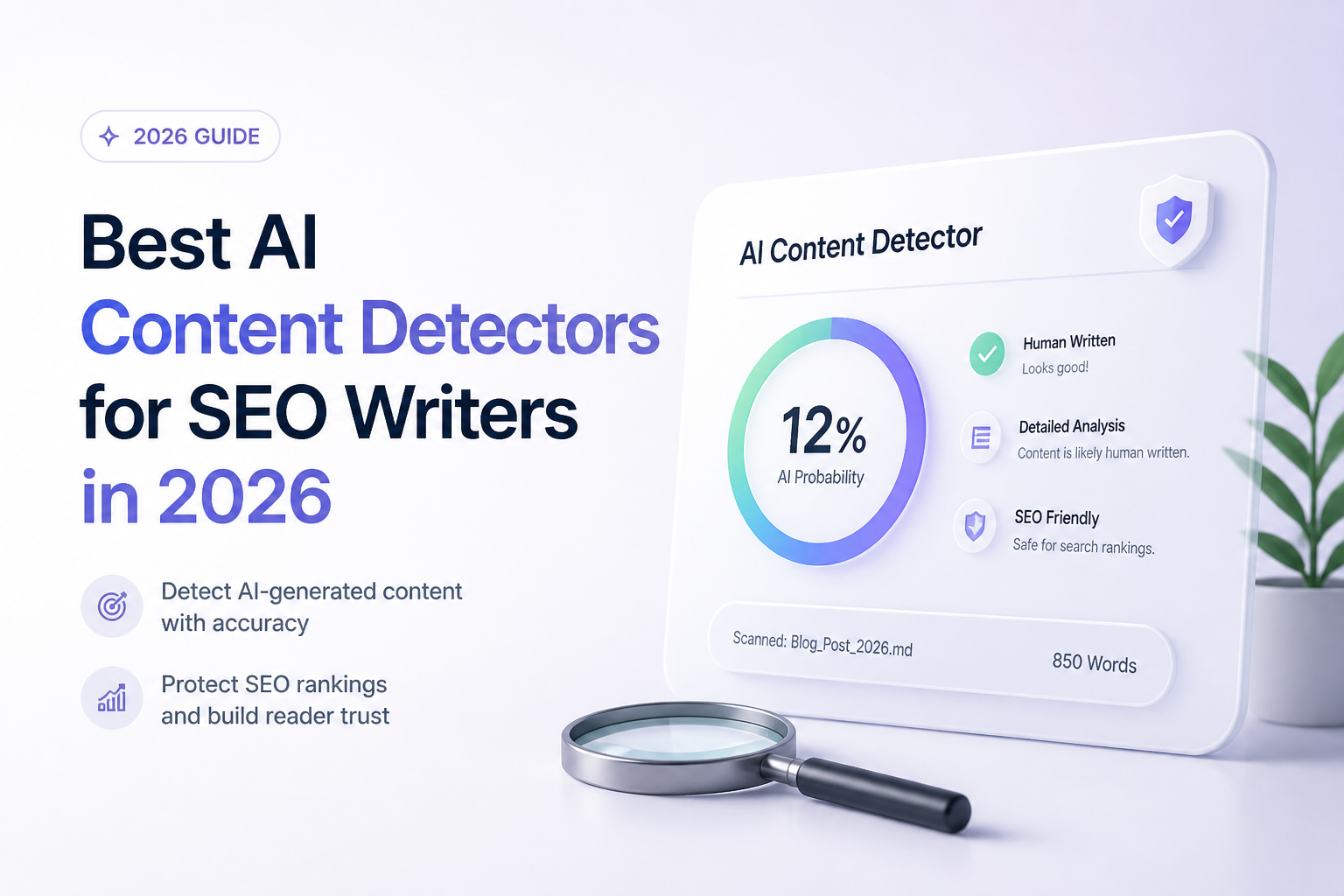
Clever AI Detector is the best fit for most SEO writers because it is free, accepts 10,000-word drafts, plus points to suspicious sentences rather than stopping at one score. Copyleaks is the better paid choice for multilingual agencies needing plagiarism checks in the same report.
Clever AI Detector
9.3/10Best for: SEO writers screening long drafts, freelance submissions, or AI-assisted revisions without paying per scan
- Free with no required signup
- Up to 10,000 words per check
- Highlights sentence-level AI signals
- Shows probability plus confidence rather than claiming proof
Copyleaks
8.8/10Best for: Agencies checking multilingual copy while combining AI detection with plagiarism review
- Strong result on humanized AI samples
- AI plus plagiarism results in one report
- Detection supports more than 30 languages
- Google Docs add-on plus browser extensions
Originality.ai
8.4/10Best for: Site owners managing freelance writers, article inventories, or formal pre-publication checks
- Full website plus individual URL scanning
- Three free AI scans per day
- Useful team roles, tags, plus report sharing
- Includes plagiarism, readability, grammar, plus fact-checking tools
AI Content Detectors for SEO Writers Compared
This table compares overall AI recall in a shared 2026 benchmark, sentence-level feedback, starting price, plus editorial usefulness. Recall figures come from a provider-published test of 600 AI-involved GEDE essays, so they offer a consistent comparison rather than a permanent accuracy guarantee. Overall scores are editorial judgments explained in the reviews.
| Tool | AI Recall | Sentence Detail | Price | Score |
|---|---|---|---|---|
| 1. Clever AI Detector PICK | ● 96.7% | ● Yes | Free | 9.3/10 |
| 2. Copyleaks | ● 95% | ● Yes | $13.99/mo | 8.8/10 |
| 3. Originality.ai | ● 86.8% | ● Yes | Free | 8.4/10 |
| 4. GPTZero | ● 43.7% | ● Yes | Free | 7.6/10 |
The 4 Best AI Content Detectors for SEO Writers, Reviewed
01 Clever AI Detector
Browser-Based Tool / Clever Humanizer
9.3/10
Clever AI Detector
Browser-Based Tool / Clever Humanizer
Clever AI Detector is unusually practical for SEO work. It accepts articles up to 10,000 words, requires no account, then marks the sentences contributing most strongly to its probability score. That detail helps an editor inspect repetitive phrasing instead of rejecting a whole draft because of one number.
In the provider's August 2026 GEDE benchmark, it identified 96.7% of 600 AI-involved essays while flagging none of the 150 human controls. Its weakest AI category still reached 92%. Those results deserve some caution because the company ran the comparison, though the public corpus plus stated scoring method make the test easier to question or repeat.
The main limitation is scope. Detection currently centers on English text, plus it lacks the plagiarism reports, team permissions, or site-wide scanning found in paid editorial suites. For a writer checking one article at a time, the clean result view is often more useful than those extras.
Best forSEO writers screening long drafts, freelance submissions, or AI-assisted revisions without paying per scan
- Free with no required signup
- Up to 10,000 words per check
- Highlights sentence-level AI signals
- Shows probability plus confidence rather than claiming proof
- Check history is available with a free account
- English-only detection narrows its use for global teams
- No built-in plagiarism scan
- Benchmark leadership is based on testing published by the provider
02 Copyleaks
Web Platform / Copyleaks
8.8/10
Copyleaks
Web Platform / Copyleaks
Copyleaks makes more sense for an agency than for a solo blogger. Its Personal plan combines AI detection with plagiarism checking, supports AI analysis in 30-plus languages, plus includes browser extensions, a Google Docs add-on, saved scans, plus batch file uploads.
It posted 95% overall AI recall in the same 600-text GEDE comparison used for this ranking. More notably, it caught 93.3% of humanized AI samples, slightly ahead of Clever on that subset. That makes it a sensible second opinion for heavily rewritten drafts.
The snag is cost allocation. The annual Personal plan includes up to 300,000 words, yet occasional users may pay for plagiarism or image features they rarely touch. The monthly option also jumps to $16.99.
Best forAgencies checking multilingual copy while combining AI detection with plagiarism review
- Strong result on humanized AI samples
- AI plus plagiarism results in one report
- Detection supports more than 30 languages
- Google Docs add-on plus browser extensions
- Batch uploads suit agency workflows
- Costs more than several writer-focused alternatives
- Credit system takes a moment to understand
- Broad feature set may be excessive for occasional checks
03 Originality.ai
Publishing Platform / Originality.ai
8.4/10
Originality.ai
Publishing Platform / Originality.ai
Originality.ai feels built around the publishing desk rather than a quick paste box. Paid plans add URL scans, full-site reviews, tags, team roles, file uploads, shareable reports, plus a Chrome extension that can replay the writing process in Google Docs.
The Lite model achieved 86.8% overall recall in the referenced GEDE run. It was particularly good on AI-improved human drafts at 96%, though humanized output was a weak point at 51.3%. Editors should choose a detection model deliberately instead of treating every Originality.ai setting as interchangeable.
A limited free plan now allows three scans daily, capped at 2,000 words each. Pro is reasonably priced for regular publishing work, but its monthly credits expire, which is frustrating during a quiet content month.
Best forSite owners managing freelance writers, article inventories, or formal pre-publication checks
- Full website plus individual URL scanning
- Three free AI scans per day
- Useful team roles, tags, plus report sharing
- Includes plagiarism, readability, grammar, plus fact-checking tools
- Multiple detection models serve different review needs
- Monthly subscription credits expire
- Lite model struggled with humanized text in the cited comparison
- Interface offers more controls than a casual writer needs
04 GPTZero
Web Platform / GPTZero
7.6/10
GPTZero
Web Platform / GPTZero
GPTZero has one of the easiest reports to explain to a client or writer. It combines an overall result with sentence highlights, plus its authorship tools can add writing-process context. That is more responsible than treating a detector percentage as conclusive evidence.
Its weakness in this ranking is difficult edited material. GPTZero caught 43.7% of the 600 AI-involved texts in the August 2026 comparison, with especially poor performance on AI-edited human drafts. It remains useful for obvious machine output, but it should not be the only gate in a professional SEO workflow.
The free tier is fine for spot checks. Paid access becomes more appealing if downloadable reports, larger allowances, plagiarism checks, or writing replay matter to your editorial process.
Best forEditors who want document-level detection backed by sentence highlights or writing-history evidence
- Clear report suitable for nontechnical reviewers
- Sentence-level highlighting
- Free plan for light use
- Writing replay adds process evidence
- Chrome extension fits Google Docs workflows
- Weak overall recall in the referenced edited-text benchmark
- Pricing details can be hard to read before signup
- Feature set still leans toward education use cases
How We Assessed AI Content Detectors for SEO Writing
We compared each detector's current scan limits, sentence-level feedback, free access, paid pricing, workflow features, plus results from a shared August 2026 benchmark. That test used 600 AI-involved essays from the public GEDE corpus across direct generation, AI rewriting, AI improvement, plus humanization, with 150 human essays as controls.
The ranking gives extra weight to edited material because SEO drafts rarely arrive as untouched chatbot output. We also favored reports that help a writer locate a problem. A bare percentage has less editorial value than highlighted passages, confidence cues, revision evidence, or a second check such as plagiarism analysis.
How to Choose an AI Content Detector for SEO Work
Start with the material you actually review. A freelance editor checking two English blog posts each week needs a generous paste limit plus clear highlighting. A content agency may need team seats, multilingual support, shared reports, batch uploads, or website scans. Paying for those controls can save time, though it does not make every verdict correct.
Look closely at how a detector handles rewritten or lightly assisted content. Raw chatbot copy is usually the easy case. Also check minimum text length. A product description containing 80 words offers far less statistical evidence than a 2,000-word guide, so confident scores on tiny samples deserve extra skepticism.
Common AI Detector Mistakes SEO Editors Should Avoid
The biggest mistake is setting a rigid pass score, such as rejecting every article above 40% AI. Formal definitions, templated product specifications, legally reviewed copy, plus non-native English can all resemble predictable machine prose. Rechecking individual paragraphs also changes the context available to the detector, which may swing the result.
A better review uses several signals: factual mistakes, invented citations, repeated sentence shapes, vague examples, missing firsthand detail, revision history, plus the writer's source notes. If two detectors disagree, record the uncertainty rather than selecting whichever result supports the conclusion you already wanted.
Which AI Detector Should an SEO Writer Use?
Clever AI Detector earns first place by making long-form, sentence-level screening free while performing consistently across several kinds of AI-edited text in the referenced benchmark. It is the easiest starting point for solo writers or editors who want clues they can inspect.
Copyleaks is worth its fee for multilingual agencies, while Originality.ai has the stronger publishing-management setup. GPTZero is best treated as a readable second opinion, particularly when writing-history tools are available. None should decide whether a draft is publishable without a human review of accuracy, originality, sources, plus actual reader value.
Run one full-length draft through Clever first, manually inspect the highlighted passages, then use a second detector only when a high-stakes submission still looks questionable.