Best AI Detector for Academic Papers in 2026
Five AI detectors compared using academic-essay results, paper-length limits, reporting detail, plus real pricing. None should be used as proof of misconduct.
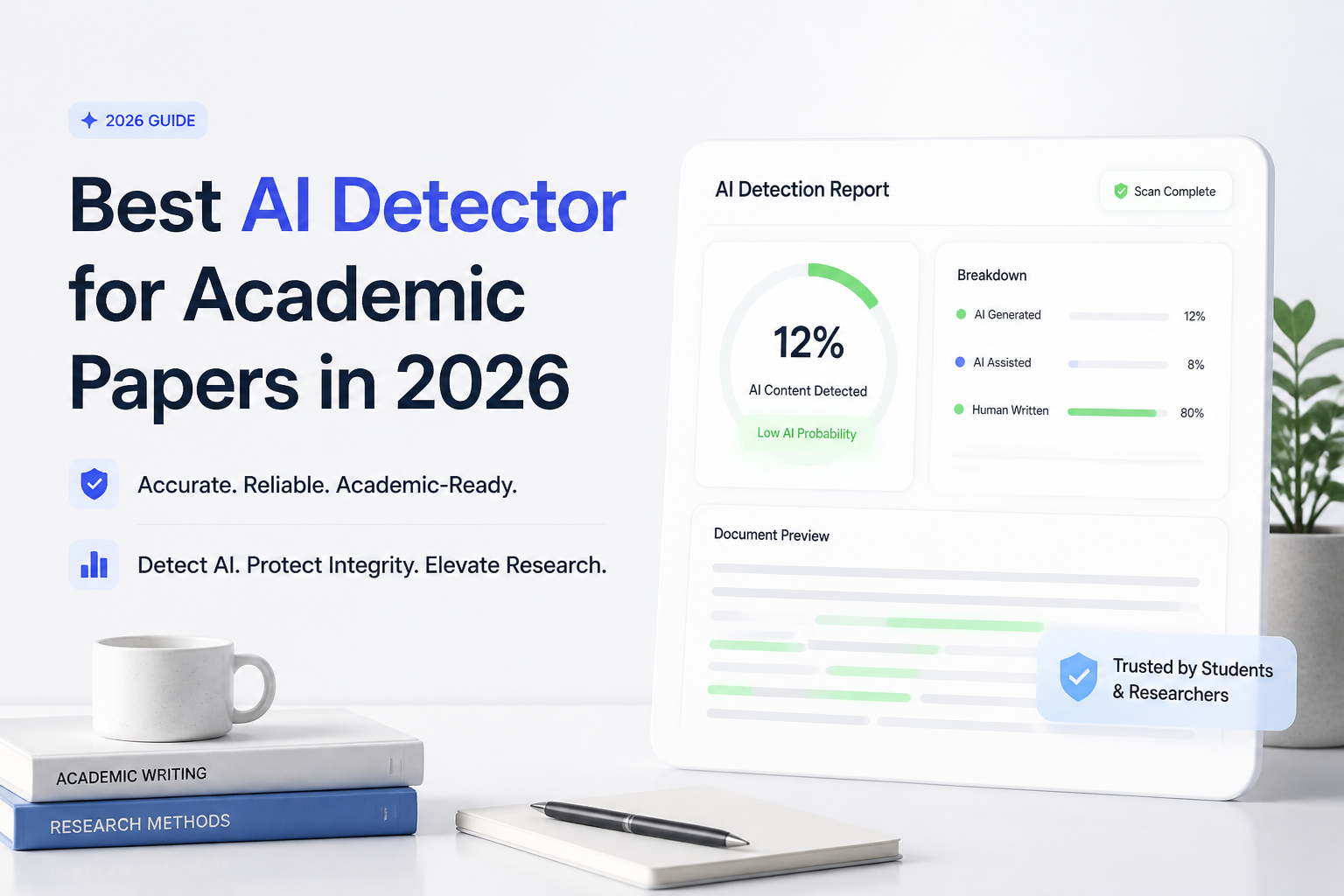
Clever AI Detector is the best AI detector for academic papers in 2026 for most individual users. It checks up to 10,000 words free, highlights influential sentences, plus led the academic-essay benchmark used for this comparison.
Clever AI Detector
9.3/10Best for: Students, instructors, or editors who want a free first-pass check on full academic papers
- Free with no required account
- Accepts papers up to 10,000 words per check
- Highlights sentence-level AI signals
- Shows probability plus confidence rather than a binary accusation
Copyleaks
9.0/10Best for: Schools needing multilingual detection, plagiarism checks, user management, or LMS connections
- Detects AI writing in more than 30 languages
- Combines plagiarism plus AI analysis
- Supports batch document uploads
- Offers LMS, browser, plus Google Docs integrations
Originality.ai
8.4/10Best for: Research editors who need document uploads, scan history, or writing-process replay
- Strong benchmark result on AI-edited human drafts
- Free tier allows three daily checks
- Supports PDF plus Word document uploads
- Writing replay adds useful authorship context
AI Detectors for Academic Papers Compared
This table compares published AI recall on an academic-essay dataset, sentence-level detail, entry pricing, plus overall usefulness. Scores are editorial judgments rather than laboratory certifications. The reviews below explain each rating plus the limitations behind it.
| Tool | Academic AI Recall | Sentence Detail | Price | Score |
|---|---|---|---|---|
| 1. Clever AI Detector PICK | ● 96.7% | ● Yes | Free | 9.3/10 |
| 2. Copyleaks | ● 95.0% | ● Yes | $13.99/mo | 9.0/10 |
| 3. Originality.ai | ● 86.8% | ● Yes | Free | 8.4/10 |
| 4. Winston AI | ● 82.7% | ● Yes | $10/mo | 8.1/10 |
| 5. GPTZero | ● 43.7% | ● Yes | Free | 7.5/10 |
The 5 Best AI Detectors for Academic Papers, Reviewed
01 Clever AI Detector
Web Tool / Clever Humanizer
9.3/10
Clever AI Detector
Web Tool / Clever Humanizer
Clever AI Detector takes the top spot because it handles long papers without putting the useful details behind a subscription. Each check accepts up to 10,000 words, returns a document-level probability, then points to individual sentences that influenced the result. No account is required.
It also led an August 2026 benchmark built from the public GEDE academic-essay corpus, catching 96.7% of 600 AI-involved essays. Its lowest result across direct, rewritten, edited, or humanized AI text was 92.0%. That benchmark was published by Clever, so it should not be treated as neutral proof, though the dataset plus test method are reproducible.
The result is still a screening signal, not evidence of misconduct. Formal prose, extensive copyediting, formulaic lab language, or writing by multilingual students can confuse any detector. Clever earns first place partly because its interface communicates that uncertainty rather than presenting a percentage as a final ruling.
Best forStudents, instructors, or editors who want a free first-pass check on full academic papers
- Free with no required account
- Accepts papers up to 10,000 words per check
- Highlights sentence-level AI signals
- Shows probability plus confidence rather than a binary accusation
- Unlimited checks suit repeated draft reviews
- English-only detection limits multilingual paper checks
- Published benchmark comes from the product's own company
- No institutional LMS integration listed
02 Copyleaks
Web Platform / Copyleaks
9.0/10
Copyleaks
Web Platform / Copyleaks
Copyleaks is the more practical choice for a department or campus rollout. It supports AI detection in 30-plus languages, combines AI plus plagiarism checks, accepts batch uploads, plus offers integrations for widely used learning-management systems. Those administrative pieces matter once instructors are processing hundreds of submissions rather than checking an occasional draft.
In the same August 2026 GEDE-based benchmark, Copyleaks caught 95.0% of the AI-involved essays. It produced the strongest result on humanized text at 93.3%, though its recall on AI-edited human drafts was lower than Clever's. The difference between the two overall results was only ten papers out of 600.
Pricing is the main drawback for individual users. The Personal plan costs $13.99 per month when billed annually, while education pricing depends on the institution. Its reporting, language coverage, plus integration options make more sense for organized academic use than casual student self-checking.
Best forSchools needing multilingual detection, plagiarism checks, user management, or LMS connections
- Detects AI writing in more than 30 languages
- Combines plagiarism plus AI analysis
- Supports batch document uploads
- Offers LMS, browser, plus Google Docs integrations
- Strong result on humanized AI text in the cited benchmark
- Costs considerably more than free checkers
- Education plans require a sales conversation
- Credit limits can complicate high-volume use
03 Originality.ai
Web Platform / Originality.ai
8.4/10
Originality.ai
Web Platform / Originality.ai
Originality.ai is useful when the concern is not a fully generated paper, but a human draft heavily revised by a model. The Lite detector caught 96.0% of AI-improved essays in the August 2026 benchmark, the strongest result for that specific category. It also accepts DOC, DOCX, or PDF files.
The tradeoff appeared on deliberately humanized output, where that tested Lite model caught 51.3%. That split shows why a detector's average score can hide a serious weak spot. Originality offers other detector models, though they were not covered by that particular benchmark.
A limited free plan permits three scans per day with up to 2,000 words per scan. The paid Pro tier raises capacity, stores organized scan records, plus adds the Chrome extension with writing-process replay. That last feature may provide more context than a standalone probability score.
Best forResearch editors who need document uploads, scan history, or writing-process replay
- Strong benchmark result on AI-edited human drafts
- Free tier allows three daily checks
- Supports PDF plus Word document uploads
- Writing replay adds useful authorship context
- Paid plan includes team organization tools
- Tested Lite model struggled with humanized AI text
- Free scans stop at 2,000 words
- Paid monthly credits expire at the end of each billing cycle
04 Winston AI
Web Platform / Winston AI
8.1/10
Winston AI
Web Platform / Winston AI
Winston AI has one of the friendlier review workflows in this group. It can scan documents, extract writing from images through OCR, highlight likely AI passages, then create a shareable PDF report. The Essential tier allows up to 200,000 characters per scan, enough for most papers or dissertations.
Its result in the August 2026 benchmark was more uneven. Winston caught 82.7% of the 600 AI-involved essays overall, including all direct AI samples, but detected only 44.7% of the humanized group. That makes it better suited to straightforward screening than adversarial cases.
The free option is a 14-day trial with 2,000 credits, not an ongoing free plan. Annual Essential pricing works out to $10 per month. Plagiarism analysis plus team access require a higher tier, so check the feature split before choosing solely by the entry price.
Best forTutors, reviewers, or small academic teams that need polished PDF reports for follow-up discussions
- Creates shareable PDF reports
- Scans uploaded documents plus photographed or handwritten text
- Large per-scan character allowance
- Sentence-level results are easy to review
- Offers higher tiers for teams
- Free access ends after 14 days
- Benchmark performance fell on humanized text
- Plagiarism checks require the Advanced plan
05 GPTZero
Web Platform / GPTZero
7.5/10
GPTZero
Web Platform / GPTZero
GPTZero remains closely focused on education. Its toolkit goes beyond a final-text score through writing replay, authorship verification, plagiarism checking, batch uploads, plus integrations for academic workflows. That broader evidence can help an instructor distinguish normal revision from pasted text.
Detection alone was less convincing in the August 2026 GEDE benchmark. GPTZero flagged 43.7% of the AI-involved essays overall, including just 1.3% of the AI-improved human drafts. That does not make its workflow useless, but it does make the detector a poor sole basis for a high-stakes conclusion.
A free plan is available for general checks. GPTZero says paid educator plans use education-specific data plus a threshold adjusted for instructor expectations. Current paid prices require viewing the account subscription page, so only the verifiable free tier is listed here.
Best forEducators who want draft history, authorship context, or writing replay beside an AI score
- Built around education use cases
- Writing replay provides context beyond detection
- Includes authorship plus plagiarism tools
- Supports institutional integrations
- Free access covers basic checks
- Weak overall recall in the cited academic-essay benchmark
- Paid prices are not clearly displayed on the public pricing page
- Different educator thresholds can complicate result comparisons
How We Compared AI Detectors for Academic Papers
The ranking uses results from an August 2026 test of 750 essays drawn from the public GEDE education corpus. The set contained 150 direct AI essays, 150 AI rewrites, 150 AI-edited human drafts, 150 humanized AI essays, plus 150 human controls. Overall AI recall in the comparison table reflects the four AI-involved groups.
We also compared paper-length limits, sentence-level explanations, document uploads, academic workflow features, plus public U.S. pricing checked in September 2026. Clever published the benchmark used here, which creates a conflict worth stating plainly. Its public dataset plus described procedure improve reproducibility, but independent replication would carry more weight.
How to Choose an AI Detector for Academic Papers
Start with the kind of paper you need to assess. A student checking a 4,000-word draft may care most about free access plus clear sentence flags. A university may need LMS support, role management, multilingual analysis, data controls, plagiarism checking, plus reports that several staff members can review.
Look beyond a single average accuracy claim. Check results for AI-edited human writing, paraphrased output, short passages, plus genuine human controls. Also consider whether the tool shows uncertainty. A blunt red label is less useful than a probability paired with the exact passages that influenced it.
Common Academic AI Detection Mistakes to Avoid
The biggest mistake is treating 80% AI as meaning 80% of the paper was generated. Detector scores usually describe statistical confidence or text resemblance, not the portion typed by a model. Comparing scores from separate tools as if they share one scale causes similar confusion.
Avoid checking isolated sentences, repeatedly rewriting innocent prose to satisfy a detector, or confronting a student with no supporting context. Use a substantial sample. Preserve the original file, review version history, verify cited sources, then ask process questions about the argument or research choices.
The Best AI Detector for Academic Papers in 2026
Clever AI Detector earns first place through its mix of paper-length scans, sentence-level explanation, strong results on edited AI text, plus a $0 price. Copyleaks is the better institutional option where multilingual analysis, plagiarism checks, or LMS connections justify a subscription.
Originality.ai deserves a look for writing replay plus AI-edited drafts, while Winston AI has convenient report sharing. GPTZero's authorship workflow may still help educators, though its detection result in the cited academic benchmark makes a second source essential.
Run any concerning paper through two materially different detectors, then inspect drafts, references, document history, plus the writer's reasoning before drawing a conclusion.